Nanotechnology enables scientists to enhance material properties for specific applications by manipulating them at the molecular level.
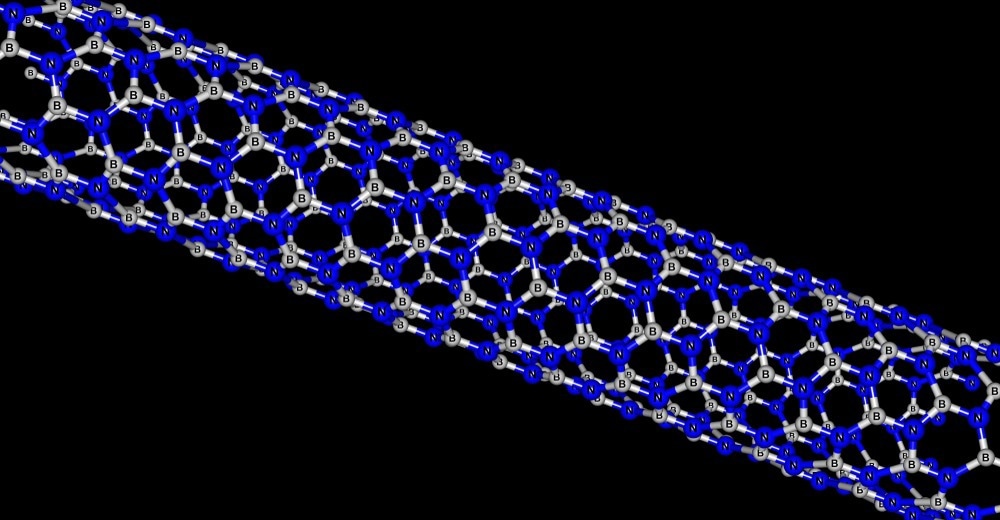
Image Credit: Igor Petrushenko/Shutterstock.com
Carbon nanotubes (CNTs) are the most frequently used nanomaterials due to their high electrical and thermal conductivity, superior mechanical properties, unique optical characteristics, low cost, and ease of fabrication.1,2
However, recent focus has shifted to boron nitride nanotubes (BNNTs), which offer advantages over traditional CNTs, making them suitable for various industrial nanotechnology products.3
CNTs vs. BNNTs: What Is the Difference?
Composition
Both CNTs and BNNTs are extensively used nanomaterials with similar crystal structures, featuring hexagonal rings and sp2 bonding. The key difference lies in their bonding: CNTs have purely covalent C-C bonds, while BNNTs have partially ionic B-N bonds due to the electronegativity difference between boron and nitrogen.
This difference gives BNNTs unique properties, making them a popular alternative to traditional CNT applications.4
BNNTs are prepared by bottom-up synthesis, involving nucleation and growth from atomistic boron and nitride-containing precursors. They can be envisioned as tubular structures formed by curling up BNNSs. These materials exhibit comparable performance in mechanics, thermal conduction, electric insulation, chemical stability, and high-temperature anti-oxidation when compared to BN.3
Layered boron nitride (BN) has a structure similar to graphite, with boron (B) and nitrogen (N) atoms replacing carbon (C) atoms. A notable composition for developing BNNTs is BC2N, known for its high Vickers hardness (up to 76 GPa), stability, and ductility. However, determining its structure is challenging due to the small grain size and the similar atomic masses of B, C, and N.5
BNNTs can be classified based on their walls, longitudinal growth, and chirality. In terms of walls, BNNTs are categorized as single-walled BNNTs (SBNNTs) and multi-walled BNNTs (MBNNTs), with SBNNTs being less frequently reported in research and applications.
Based on longitudinal growth, BNNTs are classified into straight-walled, flower-type, short bamboo-type, and long bamboo-type BNNTs.6 These varied compositions and morphologies enable BNNTs to perform efficiently under different operating conditions and applications.
Key Properties
The charge distribution in C–C bonds within CNTs is symmetric, whereas it is asymmetric in B–N bonds within BNNTs. The electron charge transfer from boron to nitrogen imparts partial ionic character to B–N bonds, unlike the purely covalent C–C bonds in CNTs. This charge transfer creates a gap between the valence and conduction bands, making BNNTs wide-gap semiconductors.
The polar nature of BN bonds allows BNNTs to consistently exhibit semiconducting behavior regardless of their varying diameters and nanoscale chiralities. However, doping BNNTs with impurities within the tube wall or through functionalization can significantly alter their electronic properties.7
A fundamental property of BNNTs is their high oxidation resistance, even in extreme environments up to 900 °C in air. They possess superior thermal and chemical stability in inert high-temperature conditions.
These characteristics make BNNTs crucial for advanced applications across various fields, including biomedical science, where they are researched for drug delivery systems and other diagnostic applications due to their non-toxicity.8
Applications of BNNTs
The unique properties of BNNTs have led to their use in various applications, including in situ probing of mechano-electronic or piezoelectric properties, creating transistors and switches without semiconductors, and enabling giant osmotic energy conversion.9
BNNTs' weak semiconducting properties require chemical or physical treatment for integration into modern electronic devices. Doping BNNTs enhances semiconductor devices by controlling and improving carrier injection, which is crucial for optimizing BNNTs for electronic devices.
Researchers have explored doping BNNTs with molybdenum (Mo) and magnesium (Mg) using first-principle methods based on density functional theory.10 This introduced defective levels in the band gap of pristine BNNTs, significantly altering their optical and electronic behaviors, thus facilitating electron transport and creating energetically favorable conditions for electronic device development.
To study doping effects, experts have fabricated cylinder-shaped and bamboo-shaped BNNTs using a novel chemical vapor reaction method.11 These BNNTs have an average diameter of around 100 nm, with individual tube lengths extending to hundreds of microns.
Cathodoluminescence (CL) analyses have revealed UV emission peaks, indicating potential use as compact UV laser emitters. Researchers found that the shape, diameter, and other morphological factors did not affect the energy band of BNNTs.
The luminescence peaks, arising from unique structural morphology and chemical impurities, further confirm BNNTs as promising materials for future high-performance nano-electronic devices.
Challenges and Future Innovations
The difficulty in synthesizing BNNTs is a significant barrier to their broader application. The process typically demands extremely high furnace or arc plasma temperatures, involves hazardous chemicals, or necessitates unique synthesis methods. These challenges often result in entangled BNNTs with impurities such as amorphous BN and boron nanoparticles, which are tough to remove.
The impurities make BNNTs difficult to disperse for various applications, significantly hampering their practical use in advanced technologies despite their promising properties12
Additionally, fabricating large-scale novel nano-electronic devices utilizing BNNTs is complex and requires extensive research. For example, creating transistors from graphene-BNNT heterojunctions is challenging due to the 3D heterojunction's need for a surrounding-gate or gate-all-around (GAA) configuration.13
Furthermore, fabricating transistors with graphene-BNNT heterojunctions using monolayer graphene is very challenging yet extremely attractive. This technique leverages graphene's high electron mobility for digital switching.
Another exciting prospect is BNNTs' applications in high-temperature environments. SWBNNTs are a focus of attention, as much work is needed to improve their thermal properties for efficient thermal management. Research includes testing the supersonic hot ablative properties of BNNT hybrid composites.
In summary, the unique properties of BNNTs have garnered significant attention in recent years, leading to novel applications not seen with CNTs, such as charged surfaces, electrical insulation, and optical transparency.
Continued creative exploration in this area, both experimentally and theoretically, is expected to yield even more attractive applications in the future.
More from AZoNano: What Role Does Boron Nitride Play in 3D Printing?
References and Further Reading
[1] Brito, C., et al. (2024). A review on carbon nanotubes family of nanomaterials and their health field. ACS omega. doi.org/10.1021/acsomega.3c08824
[2] Morais S. (2023). Advances and Applications of Carbon Nanotubes. Nanomaterials. doi.org/10.3390/nano13192674
[3] Lu, Y., et al. (2023). Boron nitride nanotubes and nanosheets: Their basic properties, synthesis, and some of applications. Diamond and Related Materials. doi.org/10.1016/j.diamond.2023.109978
[4] Kolahalam, L., et al. (2019). Review on nanomaterials: Synthesis and applications. Materials Today: Proceedings. doi.org/10.1016/j.matpr.2019.07.371
[5] Liu, L., et al. (2018). Hexagonal BC2N with remarkably high hardness. The Journal of Physical Chemistry C. doi.org/10.1021/acs.jpcc.8b00252
[6] Yanar, N., et al. (2020). Boron Nitride Nanotube (BNNT) Membranes for Energy and Environmental Applications. Membranes. doi.org/10.3390/membranes10120430
[7] Cohen, ML., Zettl, A. (2012). The physics of boron nitride nanotubes. World of Physics. doi.org/10.1063/1.3518210
[8] Maselugbo, A. et. al. (2022). Boron nitride nanotubes: A review of recent progress on purification methods and techniques. Journal of Materials Research. 37. 4438–4458. Available at: https://doi.org/10.1557/s43578-022-00672-5
[9] Zhang, D., et al. (2021). Emerging applications of boron nitride nanotubes in energy harvesting, electronics, and biomedicine. ACS omega. doi.org/10.1021/acsomega.1c02586
[10] Soares, G., Guerini, S. (2011). Structural and electronic properties of impurities on boron nitride nanotube. Journal of Modern Physics. doi.org/10.4236/jmp.2011.28102
[11] Zhong, B., et al. (2011). Large-Scale Fabrication of Boron Nitride Nanotubes via a Facile Chemical Vapor Reaction Route and Their Cathodoluminescence Properties. Nanoscale Res Lett. doi.org/10.1007/s11671-010-9794-8
[12] Zhang, D., et al. (2022). The rise of boron nitride nanotubes for applications in energy harvesting, nanoelectronics, quantum materials, and biomedicine. Journal of Materials Research. doi.org/10.1557/s43578-022-00737-5
[13] Parashar, V., et al. (2015). Switching Behaviors of Graphene-Boron Nitride Nanotube Heterojunctions. Sci Rep. doi.org/10.1038/srep12238
Disclaimer: The views expressed here are those of the author expressed in their private capacity and do not necessarily represent the views of AZoM.com Limited T/A AZoNetwork the owner and operator of this website. This disclaimer forms part of the Terms and conditions of use of this website.