Aug 27 2005
This article was updated on the 19th August 2019.
Single-wall carbon nanotubes were discovered in 1991 by Sumio Iijima of Japan, a researcher for Japanese computer giant NEC Corporation. In 2004, the company asserted that any company that wants to manufacture or sell carbon nanotubes must first negotiate a license on NEC’s two seminal patents. In 2004, Japan’s Sumitomo Corporation was the first company to negotiate a license.
Patenting Carbon Nanotubes
IBM also holds an early and fundamental patent on single-wall carbon nanotubes. US Patent No. 5,424,054 has been identified by patent lawyers as one of the ten most important patents that could have an impact on the future development of nanotechnology. IBM’s patent was licensed to Carbon Nanotechnologies, Inc. (CNI).
CNI is the self-described “pre-eminent world producer” of carbon nanotubes. The Houston based company was founded in 2000 by Rice University Nobel Laureate and entrepreneur, Richard Smalley. According to CNI’s president, Bob Gower, the company holds a portfolio of 30 patents related to carbon nanotubes and approximately 12 of them give CNI a lock on the nanotube market.
In addition, CNI has 70 patent applications pending that include 4,000 claims on nanotube compositions, methods of production and end-use applications.
The Patenting Strategy
The company sees its patent portfolio as the key to its survival. CNI’s Chief Financial Officer was quoted in an article in Small Times: “IP protection is critical for everything we’ve done. IP gives us the freedom to price appropriately and keep others from nipping at the door.”
CNI’s strategy is to stake claims on the dominant methods used to manufacture carbon nanotubes. Richard Smalley asserts that his company has “an exceptional intellectual property position in all the process routes” – i.e., in those that are considered practical for large-scale commercial production of single-wall carbon nanotubes.
Which Products Can Carbon Nanotubes Be Used In?
CNI has about 500 customers, including many commercial firms that are purchasing tiny amounts of nanotubes to test in products ranging from plastics, batteries, and water purification systems to aerospace, defense and space exploration. Samsung is currently using CNI’s carbon nanotubes to create a new generation of energy-saving, flat-screen televisions.
|
|
|
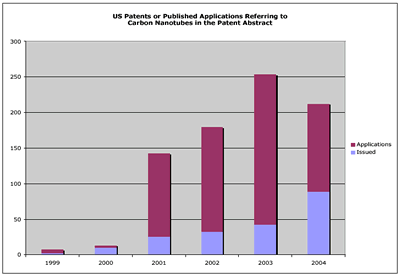
Figure 1. US patents or published applications referring to carbon nanotubes in the patent abstract.
|
Hyperion Catalysis and Multi-Wall Carbon Nanotubes
Hyperion Catalysis based in Cambridge, Massachusetts (USA) claims that its multi-wall carbon nanotubes were first synthesized in 1983 and the company holds a seminal patent issued in 1985.
The company sells multi-wall nanotubes dispersed in a range of plastics for commercial, automotive and electronics applications. Worldwide, fewer than 20 companies are making commercial quantities of carbon nanotubes.
List of Companies and Organizations Who Hold Patents for Carbon Nanotubes
Table 1. Carbon nanotube patents issued by US PTO, from 1999-2004 (the data was collected on 25 April 2005).
|
|
|
Samsung Electronics and Samsung SDI Co., Ltd.
|
Korea
|
23
|
|
Rice University
|
USA
|
14
|
|
Hyperion Catalysis International, Inc.
|
USA
|
10
|
|
The United States of America
|
USA
|
9
|
|
University of Kentucky Research Foundation
|
USA
|
8
|
|
Industrial Technology Research Institute
|
Taiwan
|
8
|
|
NEC Corp. and Research Institute, Inc.
|
Japan
|
7
|
|
Iljin Nanotech CO., Ltd.
|
Korea
|
6
|
|
Battelle Memorial Institute
|
USA
|
5
|
|
The Regents of the University of California
|
USA
|
4
|
|
Agency of Industrial Science and Technology
|
Japan
|
4
|
|
Hitachi, Ltd.
|
Japan
|
4
|
|
LG Electronics, Inc
|
UK
|
4
|
|
Stanford University
|
USA
|
4
|
Producers of Carbon Nanotubes in Europe and Asia
Nanocyl S.A. (Belgium) is the leading manufacturer and developer of carbon nanotubes in Europe. Other players include Nanoledge in France, Rosseter Holdings in Cyprus; South Korea’s ILJIN; Moscow’s Nanocarblab; Shenzhen Nanotech Port Co. in China and Tokyo’s Carbon Nanotech Research Institute.
Patenting Carbon Nanotubes - an Overview of the Current Climate
- Carbon nanotubes represent an important component in nanotech-related materials, and will, therefore, affect traditional commodity markets and demands for raw materials. Concerns about ownership and control of carbon nanotubes are especially relevant to the newly industrialized Global South.
- ETC Group’s list of top patent assignees (see table 1) related to carbon nanotubes reveals that ownership of carbon nanotube patents is highly fragmented, and there are numerous players across diverse industries.
- There were 140 different primary patent examiners for the 257 patents on nanotubes issued by the US PTO. The lack of uniform handling increases the likelihood that different examiners in different departments reviewed different prior art, and this could result in overlapping patent claims.
- ETC Group agrees with analysts who conclude that a nanotube patent thicket exists. A swarm of existing patents, whose claims are often broad, overlapping and conflicting, means that researchers hoping to develop new technology based on carbon nanotubes must first negotiate licenses from multiple patent owners.
- Lux Research, a nanotechnology consulting firm, conducted its own study of the IP nanotech landscape. The Lux report concludes that “nanotube patents look messy in electronics,” but they found that carbon nanotube patents are not a problem in all areas (especially energy, healthcare, and cosmetics).
- Since patent databases do not always reveal the current ownership of patents or disclose assignees, our list of leading carbon nanotube patent assignees is not necessarily a true reflection of a company or institution’s dominant position. For example, CNI claims that it has an exceptional IP position in all the process routes for producing carbon nanotubes, but it is not immediately apparent by conducting patent searches. However, CNI has licensed nanotube patents from Rice University. (Richard Smalley is both a Rice faculty member and founder of CNI.)
- The number of US patents already granted which relate to carbon nanotubes is considerable, but the number of patent applications received by US PTO from 2001-2004 is far greater suggesting that there could be increased activity in the nanotube patent area in the immediate years ahead. As set out above, US PTO patent applications do not always reveal patent assignees, so it is impossible to predict which companies/institutions are most actively seeking patents in this area, or by whom the patents, if granted, will be controlled.
Source
ETC Group report entitled ‘Nanotech’s “Second Nature” Patents: Implications for the Global South’, April/May 2005.