Photocatalytic nanoparticles, as the name suggests, exhibit catalytic activity when activated with light. The material which has been found to have the most photocatalytic activity is titanium dioxide (TiO2), although several other semiconducting nanomaterials have been investigatedm such as titanium disilicide (TiS2).
TiO2 nanoparticles are activated by light in the UV range, or at the very far end of blue visible light. The nanoparticles effectively transfer the energy from this light into organic compounds, which in most cases is enough to decompose the compound altogether. This makes the photocatalytic particles effective as a cleaning agent.
Anti-Fogging and Easy-Cleaning Glass
One of the most common applications for this technology is not strictly photocatalytic. No chemical reaction occurs - the surface, which has been treated with TiO2 nanoparticles, simply becomes highly hydrophilic (water attracting) when exposed to UV light. This makes the water spread out over the surface, covering it in a thin transparent film rather than beading up into droplets.
This prevents fogging of glass and shiny metal surfaces, and also makes the surface significantly easier to clean, as organic materials is unable to adhere to the surface directly. The surface can therefore be easily cleaned with a wipe, or a spray with fresh water - outdoor surfaces are cleaned effectively by rainfall.
Self-Cleaning and Antibacterial Surfaces
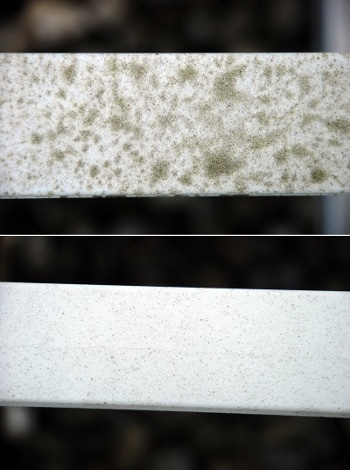 |
| Figure 1. TiO2 nanoparticles can keep surfaces clean for months, or even years, by catalytically decomposing organic matter and killing off microbes with the free radicals produced. Image credit: "Cleaning with Sunlight", Frauenhofer IGB |
Some surfaces have been designed to go one step further - when UV activated TiO2 nanoparticles catalytically decompose organic molecules, they produce free radicals - highly reactive compounds which are toxic to bacteria and fungi. This makes TiO2-treated surfaces self-sterilizing, which is extremely useful for medical applications, and in the food industry.
Self-cleaning surfaces using photocatalytic nanoparticles have also been developed for the sides of buildings, outdoor furniture, and glass surfaces such as smartphone screens. Researchers at Frauenhofer IGB have been optimizing the nanoparticle coatings for various applications, and have produced thin-film coatings and paints which will keep furniture free of moss and fungi for two years, and will clean fingerprints and dirt off a smartphone with just one hour or exposure to sunlight.
Air and Water Filtration
Photocatalytic nanoparticles have also been suggested as a treatment or additive for water and air filters. This could help to sterilize air in clean rooms or laboratories, and to decompose harmful volatile organic compounds (VOCs) in exhaust gases from factories or chemical plants before they are released to the atmosphere.
Water treatment is a less developed application of photocatalytic technology. Water treatment systems designed for use in swimming pools are already commercially available, but there is great interest in using the technology, in tandem with existing treatment systems, to make clean and safe drinking water more available in developing countries and in remote locations. Photocatalysis could eventually form an important part of waste water treatment and recycling.
Photocatalytic Water Cleavage for Hydrogen Production
Although this application is currently in the research stage, photocatalysis is considered to be an excellent candidate for affordable production of hydrogen. Various types of nanoparticles have been investigated as candidates for this application, including nickel, ruthenium, and bismuth iron oxide.
At the consumption stage, hydrogen looks like a perfect fuel - it burns efficiently, and produces nothing more harmful than pure water. However, production of hydrogen by the methods used currently requires huge amounts of energy, which is most likely to come from fossil fuels, negating the green credentials of the hydrogen fuel.
Technologies like photocatalysis could open up the route to truly carbon-neutral hydrogen, which would no doubt speed its adoption for use in vehicles and stationary fuel cells.
Conclusions
There is no doubt that TiO2 nanoparticles are a revolutionary cleaning and sterilization technology. As their use becomes more widespread, we will see fewer and fewer dirty surfaces in everyday life. Moreover, the ease of cleaning of TiO2-treated surfaces will reduce the amount of harsh cleaning chemicals used, which will have a positive environmental impact.
Research is ongoing into other photocatalytic nanomaterials, particularly ones which could be tuned to a more specific energy range, enabling catalysis of more specific chemical processes, rather than just broadband decomposition. If photocatalytic chemical reactions become common in the future, it will be a significant step towards the sustainability of the chemical industry, as photocatalysis is a highly efficient way to utilize the power of the sun, without having to use the inefficient intermediary stage of photovoltaic conversion to electricity.
References
- "Applications of Photocatalysis" - EU ObservatoryNano
- "Photocatalytic Hydrogen Evolution under Highly Basic Conditions" - Yamada et al., J. Am. Chem. Soc., 2011. DOI: 10.1021/ja206079e
- "Photocatalytic hydrogen evolution with Ni nanoparticles" - Yamada et al, Energy Environ. Sci., 2011. DOI: 10.1039/C2EE03106J
- "Photocatalysis for Water Treatment" - EU ObservatoryNano