Apr 29 2009
Scientists in Japan are reporting an advance toward giving artificial cells another hallmark of life - the ability to tap an energy source and use it to undergo sustained movement. Their study, published in the Journal of the American Chemical Society, describes the first "self-propelled" oil droplets (used as a model for research on artificial cells) that can run on a chemical "fuel."
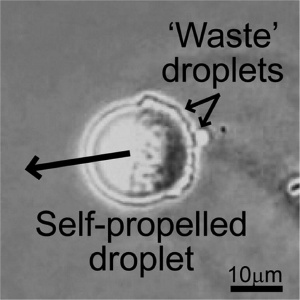 Scientists are reporting development of "self-propelled" oil droplets that run on chemical "fuel." The development could serve as a blueprint for designing similar locomotion systems in artificial cells. Credit: The American Chemical Society
Tadashi Sugawara and Taro Toyota and other colleagues note in the new study that scientists have tried for years to find a method for producing oil droplets that undergo controlled movement from one point to another. Despite identifying several promising approaches, researchers have never found an ideal method that they can easily control.
The new study describes development of oil droplets equipped with chemical "engines" - highly reactive catalysts - that provide self-propelled motion in the presence of a chemical "fuel." This fuel consists of special substances that react in the presence of the catalyst. When the researchers placed droplets in water containing the fuel, the droplets moved in a controlled fashion toward areas with the highest concentration of fuel. The researchers also say that when another droplet comes close the newcomer it is trapped by the trail of wastes released by the first droplet. Then the two move together in a "communicative" manner. When the fuel was exhausted, the droplets slowed down and stopped. The study serves as a long-awaited blueprint for designing similar locomotion systems in artificial cells, the scientists say.