May 29 2009
True muonium, a long-theorized but never-seen atom, might be observed in future experiments, thanks to recent theoretical work by researchers at the Department of Energy's SLAC National Accelerator Laboratory and Arizona State University. True muonium was first theorized more than 50 years ago, but until now no one had uncovered an unambiguous method by which it could be created and observed.
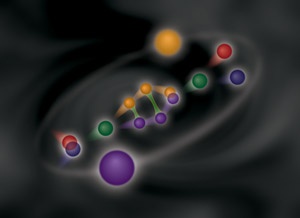 In this artist's depiction of how experimentalists could create true muonium, an electron (blue) and a positron (red) collide, producing a virtual photon (green) and then a muonium atom, made of a muon (small yellow) and an anti-muon (small purple). The muonium atom then decays back into a virtual photon and then a positron and an electron. Overlaying this process is a figure indicating the structure of the muonium atom: one muon (large yellow) and one anti-muon (large purple). (Graphic: Terry Anderson, SLAC.)
"We don't usually work in this area, but one day we were idly talking about how experimentalists could create exotic states of matter," said SLAC theorist Stanley Brodsky, who worked with Arizona State's Richard Lebed on the result. "As our conversation progressed, we realized 'Gee…we just figured out how to make true muonium.'"
True muonium is made of a muon and an anti-muon, and is distinguished from what's also been called "muonium"—an atom made of an electron and an anti-muon. Both muons and anti-muons are created frequently in nature when energetic particles from space strike the earth's atmosphere. Yet both have a fleeting existence, and their combination, true muonium, decays naturally into other particles in a few trillionths of a second. This makes observation of the exotic atom quite difficult.
In a paper published this week in Physical Review Letters, Brodsky and Lebed describe two methods by which electron–positron accelerators could detect the signature of true muonium's formation and decay.
In the first method, an accelerator's electron and positron beams are arranged to merge, crossing at a glancing angle. Such a collision would produce a single photon, which would then transform into a single true muonium atom that would be thrown clear of the other particle debris. Because the newly created true muonium atoms would be traveling so fast that the laws of relativity govern, they would decay much slower than they would otherwise, making detection easier. [An artist's impression of this process can be seen at right.]
In the second method, the electron and positron beams collide head-on. This would produce a true muonium atom and a photon, tangled up in a cloud of particle debris. Yet simply by recoiling against each other, the true muonium and the photon would push one another out of the debris cloud, creating a unique signature not previously searched for.
"It's very likely that people have already created true muonium in this second way," Brodsky said. "They just haven't detected it."
In their paper, Lebed and Brodsky also describe a possible, but more difficult, means by which experimentalists could create true tauonium, a bound state of a tau lepton and its antiparticle. The tau was first created at SLAC's SPEAR storage ring, a feat for which SLAC physicist Martin Perl received the 1995 Nobel Prize in physics.
Brodsky attributes the pair's successful work to a confluence of events: various unrelated lectures, conversations and ideas over the years, pieces of which came together suddenly during his conversation with Lebed.
"Once you pull all of the ideas together, you say 'Of course! Why not?' Brodsky said. "That's the process of science—you try to relate everything new to what you already know, creating logical connections."
Now that those logical connections are firmly in place, Brodsky said he hopes that one of the world's colliders will perform the experiments he and Lebed describe, asking, "Who doesn't want to see a new form of matter that no one's ever seen before?"
SLAC National Accelerator Laboratory is a multi-program laboratory exploring frontier questions in photon science, astrophysics, particle physics and accelerator research. Located in Menlo Park, California, SLAC is operated by Stanford University for the U.S. Department of Energy Office of Science.