Jul 21 2009
The National Institutes of Health has awarded Albert Einstein College of Medicine of Yeshiva University a five-year, $10 million grant to study how the motion of atoms on both extremely small and long time scales contribute to enzyme function. This work has the potential to provide the deepest possible understanding of the chemical reactions that are both central to life and become dysfunctional in disease states.
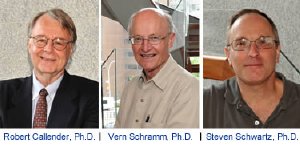 Einstein principal investigators
Enzymes are proteins that increase the rate of, or catalyze, chemical reactions within cells. It is well known that atomic motion alters the shape of proteins over relatively broad time scales, from milliseconds (thousandths of seconds) to seconds. These motion-induced changes affect the speed of enzymatic reactions, since enzymes and the molecules they interact with (substrates) must have specific shapes for the reactions to proceed.
Until recently, researchers have lacked the tools to study protein motion on a sub-millisecond time scale. Theoretical and experimental techniques developed at Einstein and at Emory University now allow investigators to “watch” these chemical reactions from the shortest timescales to the longest, from picoseconds to milliseconds. (A picosecond is one trillionth of a second). These emerging technologies include nanosecond laser spectroscopies and ultrafast microfluidic mixing, which are coupled with innovative computational analyses.
“Some of our findings to date challenge long-held textbook understanding of enzymatic catalysis,” says study leader Robert Callender, Ph.D., professor of biochemistry at Einstein.
In the conventional view, an enzyme combines with a substrate to form what is known as the Michaelis complex, ultimately leading to a new molecule — the product. “But it turns out to be more complicated than this,” Dr. Callender explains. “If you look at this process more deeply, you see all these different enzyme-substrate conformations, numbering in the thousands, even hundreds of thousands. Our hypothesis is that not all of these conformations are equally active — just a few actually lead to the product. In addition, the protein body of the enzyme functions more as a chemical machine than simple organic catalyst. This stands classical enzymology on its head.”
These findings may have important implications for drug design since enzymes are targets for a broad array of pharmaceuticals. “How atomic motion in proteins brings about enzymatic catalysis is very poorly understood,” explains Dr. Callender. “The detailed structure of the enzymatic transition state is a powerful target for drug design, and increased knowledge of how enzymes form this state is fundamental for all catalysts and specifically for designing new classes of drugs.”
The research program is divided into four projects:
- “Energy Landscapes Encoding Function in lactate dehydrogenase (LDH) Over Broad Time Scales.” LDH is an enzyme that catalyzes the conversion of lactate to pyruvate, an important step in energy production in cells. The principal investigator is Dr. Callender, professor of biochemistry at Einstein.
- “Protein Dynamic Contributions to Transition State Formation in purine nucleoside phosphorylase (PNP).” PNP is an enzyme that helps to degrade nucleotides and nucleic acids and has emerged as a drug target in a variety of diseases including cancer and autoimmune dysfunction. The principal investigator is Vern L. Schramm, Ph.D., professor and Ruth Merns Chair of biochemistry at Einstein.
- “Mapping the Energy Landscape of Catalysis in dihydrofolate reductase (DHFR).” DHFR is an enzyme needed for synthesizing DNA, RNA and protein. It is a target for methotrexate and other DHFR inhibitors used in treating diseases including rheumatoid arthritis and cancer. The principal investigator is R. Brian Dyer, Ph.D., of Emory University.
- “Energy Landscapes and Motional Timescales in Enzyme Catalysis.” The principal investigator is Steven D. Schwartz, Ph.D., professor of physiology and biophysics and of biochemistry at Einstein.