Aug 3 2009
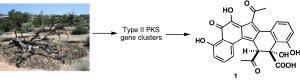
Researchers have not yet found a way to turn dirt into gold, but they are trying to find something valuable in it nonetheless: starting materials for novel pharmaceuticals. As reported in the journal Angewandte Chemie, a research team headed by Sean F. Brady at the Rockefeller University in New York has now isolated DNA from "dirt" (samples of desert soil from Utah) that encodes enzymes for a new biosynthetic pathway to make polyketides. After introducing this DNA into Streptomyces albus, this bacteria produced a previously unknown natural product named erdacin, which is a highly active antioxidant.
 © Wiley-VCH
We owe a number of our modern drugs to microorganisms, especially various antibiotics. Every habitat contains countless previously unknown microbes. One approach to the search for new drugs is thus the cultivation of such microbes in the laboratory. Extracts of their cultures can then be tested for biological activity. However, the majority of these microorganisms cannot be cultivated under current laboratory conditions. It has previously been shown that cultivation is not necessarily required in order to gain access to the natural products microbes produce: DNA can be extracted directly from environmental samples, such as a handful of soil, and stored in “environmental DNA libraries”.
It is a particular challenge to extract complete groups of genes that belong together, known as gene clusters, from such libraries. Brady’s team has now been able to isolate genes that encode enzymes for a special biosynthetic pathway (Type II polyketide synthase pathway) from a library of DNA extracted from desert soil. The researchers incorporated the genes from the desert soil into the bacterium Streptomyces albus, which then produced a novel polyketide. Polyketides are a group of natural products; their common trait is their biosynthesis by way of polyketide precursors. Their chemical structures and biological properties vary widely. Polyketides include many important drugs, including tetracycline and the antibiotic erythromycin.
The new polyketide, produced by the gene cluster isolated from soil, was named erdacin, which is derived from the Anglo-Saxon word “erda” for soil. By using NMR spectroscopy and X-ray structural analysis, they were able to determine its structure: a pentacyclic ring system made of one five-membered and four six-membered rings that are linked in a previously unknown manner. Erdacin is a strong antioxidant that is twice as active as well-known antioxidants such as vitamin C.