Good news for people fearful of needles and squeamish of shots: Scientists at the 238th National Meeting of the American Chemical Society report the design of a painless patch that may someday render hypodermic needles - as well as annual flu shots - a thing of the past. Lined with tiny "microneedles," these patches could make treatment of diabetes and a wide range of other diseases safer, more effective and less painful. Used as tiny hypodermic needles, they could improve treatment of macular degeneration and other diseases of the eye.
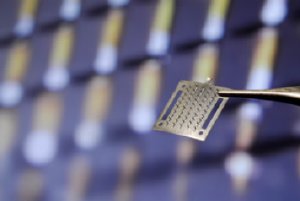 An array of microneedles like this could be coated with medicine and act as a painless drug delivery system for flu vaccines, diseases of the eye and more. Credit: Gary Meek
"It's our goal to get rid of the need for hypodermic needles in many cases and replace them with a patch that can be painlessly and simply applied by a patient," says Mark Prausnitz, Ph.D. "If you can move to something that's as easy to apply as a band-aid, you've now opened the door for people to self-administer their medicine without special training."
Prausnitz says that advances in the electronics industry in microfabricating very small objects like transistors enabled the development of microneedles. "We've built off those technological advances to address a need in medicine," he explains. "We're trying to bring the two worlds together." Each needle is only a few hundred microns long, about the width of a few strands of human hair.
Prausnitz and his colleagues at the Georgia Institute of Technology suggest that the microneedle patch could, for instance, replace yearly trips to the doctor for flu shots.
"Although it would probably first be used in a clinical setting, our vision is to have a self-administered flu vaccine patch. So instead of making an appointment with your doctor to get your flu shot, you can stop by the pharmacy or even get a patch in the mail and self-apply. We think that could very much increase the vaccine coverage since it would be easier for people to be vaccinated," Prausnitz explains.
In a collaboration with Emory University, Prausnitz and his team administered flu vaccines via conventional injections and microneedle patches in mice. After exposing the mice to the flu, they compared the resulting immune response and antibody levels. They found that the antibody levels were the same by either route. Taking a closer look, they discovered that microneedle delivery resulted in a better protective immune response by other measures.
"Toward the goal of a flu vaccine patch, we are continuing the animal studies, but we're also working toward our first human trial, which we hope to do in 2010," Prausnitz says.
Microneedles are not just able to deliver drugs through the skin - they can also be used for targeted drug delivery in the eye. They may help create an improved treatment for macular degeneration, the leading cause of blindness in the United States.
In recent years, macular degeneration has become treatable thanks to new drugs that halt and partially reverse the disease. The new drugs are a victory for the millions of patients suffering macular degeneration, but the treatment is not pleasant - the drugs must be injected directly into the eye every month.
"For the squeamish there are obvious drawbacks, but more importantly, there are real safety concerns about that kind of repeated injection into the eye. With a microneedle, we can still do the same kind of concept, injecting something into the eye, but we can now do it with a very short needle that doesn't penetrate all the way in," says Prausnitz, adding that "no one else is working on microneedle-based drug delivery to the eye."
He notes that microneedle treatments of the eye can target specific tissues in the eye. "In localizing the delivery, microneedle treatments for macular degeneration and other diseases of the eye may prove safer than conventional needles. We're now doing experiments with rabbits and non-human primates - we hope to have the first human trial in the next few years," says Prausnitz.