Aug 20 2009
Max Planck Innovation and PerkinElmer conclude a licensing agreement for highly efficient detectors for medical technology
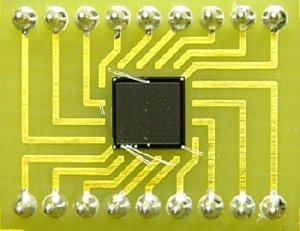 Chip with insight: silicon photomultipliers could help to locate tumours in the body more accurately - without the disadvantages and side effects of other procedures. Credit: MPI for Physics / Masahiro Teshima Image: MPI for Physics / Masahiro Teshima
In future, it will be possible to detect malignant tumors more rapidly and more reliably - with instruments that combine magnetic resonance tomography and positron emission tomography, two conventional methods in medical diagnostics. The US company PerkinElmer Inc. develops detectors for such instruments, and will be using detector technology developed by astronomers at the Max Planck Institute of Physics for this application. Max Planck Innovation has now concluded a licensing agreement with PerkinElmer that grants the company the exclusive right to use these silicon photomultipliers (SiPM).
Medical diagnosis is often a matter of weighing up the options. This begins with the selection of the right method: Although magnetic resonance tomography (MRT) supplies pinpoint sharp images of organs, bones and connective tissue, it provides no information on the metabolic activity in individual regions. An MRT is therefore not much use when looking for tumors which reveal themselves by their particularly high sugar metabolism. But this is exactly what is detected by positron-emission tomography (PET), although it does not disclose the exact locations of the active cells. Computer tomography, on the other hand, solves this dilemma, but involves additional X-ray exposure for patients.
Detectors used by the Max Planck physicists to detect cosmic gamma radiation are now facilitating the combination of PET and MRT in one instrument. The detectors that positron-emission tomographs normally employ to count photons are not suitable for such a combination because the MRT's strong magnetic field thwarts the detection of photons. Consequently, the first integrated PE and MR tomographs operate with the aid of avalanche photodiodes (APD). These have a much lower sensitivity, are slower and consume more power than the silicon photomultipliers which were originally developed by Russian researchers at the Moscow State Engineering Physics Institute, and have finally been developed further for practical applications by the group of Max Planck researchers headed by Masahiro Teshima and Razmik Mirzoyan.
"We are convinced that the SiPM technology will be very useful in medicine and environmental technology," says Michael Ersoni, Vice President of PerkinElmer and General Manager of the global detection business. PerkinElmer and Max Planck Innovation GmbH, the technology transfer company of the Max Planck Society, have concluded an exclusive licensing agreement for the silicon photomultipliers. However, these highly sensitive detectors could be used wherever it is important to detect the minutest quantities of light. In addition to the PET diagnostic application, Ersoni gives analytical fluorescence measurements as a further example.
"PerkinElmer is the world's leading company for photodetectors and therefore the ideal industrial partner to enable us to introduce the silicon photomultipliers into medical applications and analytical applications for the environment," says Bernd Ctortecka, patent and licensing manager at Max Planck Innovation: "The global operator commands a strong market position, the necessary development capacity and the experience to introduce the technology into a market that is currently undergoing rapid development."