Aug 25 2009
A researcher affiliated with Johns Hopkins Institute for NanoBioTechnology has developed a highly sensitive test using quantum dots to detect external chemical modifications to DNA called methylations. Alterations to DNA that do not involve a change in the genetic code, yet can influence gene expression, fall into the emerging science of epigenetics.
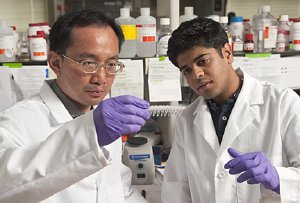 Jeff Wang, an associate professor of mechanical engineering, and biomedical engineering doctoral student Vasudev Bailey examine samples of modified DNA during a new test designed to detect early genetic clues linked to cancer. Photo by Will Kirk
The nanotechnology based test for epigenetic markers could be used as an early detection method for cancer or to determine whether a particular cancer treatments is working or not. The research was performed by INBT affiliated faculty member Jeff Tza-Huei Wang, an associate professor of mechanical engineering from the Whiting School of Engineering, and Stephen Baylin, deputy director of the Johns Hopkins Kimmel Cancer Center. Their findings were published in the August 2009 issue of Genome Research. Read the full story from Johns Hopkins University News and Information here: releases.jhu.edu/2009/08/17/new-dna-test-uses-nanotechnology-to-find-early-signs-of-cancer/
The Johns Hopkins Institute for NanoBioTechnology (INBT) at Johns Hopkins University brings together researchers from:Bloomberg School of Public Health, Krieger School of Arts and Sciences, School of Medicine, Applied Physics Laboratory and Whiting School of Engineering to create new knowledge and new technologies at the interface of nanoscience and medicine.