Sep 10 2009
Dr. Dentcho Genov, an assistant professor of physics and electrical engineering at Louisiana Tech University and a Louisiana Optical Network Initiative (LONI) Institute fellow, is featured on the cover of the most recent issue of Nature Physics, one of the most respected and prestigious physics journals in the world.
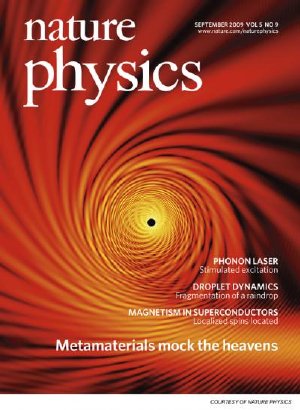 This is the cover of Nature Physics' September 2009 issue. Credit: Image courtesy of Nature Physics
Genov's groundbreaking work titled, "Mimicking celestial mechanics in metamaterials," links the newly emerging field of artificial optic materials with celestial mechanics in order to investigate celestial phenomenon in a controlled laboratory environment. Metamaterials are artificial structures that display properties beyond those available in naturally-occurring materials.
"Nature Physics is the leading physics magazine in the world and only features research that, according to their criteria, is of 'extreme importance to scientists in a specific field' and that has broad interest," says Genov.
"This recognition shows the importance placed by the international physics community on the research Dr. Genov brings to Louisiana Tech," says Dr. Lee Sawyer, professor and physics program chair in Louisiana Tech's College of Engineering and Science.
Genov along with researchers from the National Science Foundation (NSF) Nanoscale Science and Engineering Center at the University of California and the Lawrence Berkeley National Laboratory in Berkeley collaborated on this article.
Using elements of Einstein's theory of relativity, this research allows scientists to observe more closely how light and matter behave around massive celestial objects such as "black holes."
The effect on light due to curved space-times generated by complex gravitational fields can now be reproduced with precisely engineered artificial optical materials, referred to in the literature as "metamaterials."
"It may be possible, in the very near future for scientists to closely study the interaction of light with strange objects such as 'black holes' or to borrow from the stability of planetary motion to create new types of near-perfect optical traps that can effectively 'store' light," says Genov.
This featured research is also closely related to technology Genov and others helped develop for the "invisibility cloak", which involves metamaterials that can conceal objects from almost anything that travels as a wave, including light, sound and, at the subatomic level, matter itself.
"The future of metamaterials for both research and application is still uncharted territory," says Sawyer. "What Dr. Genov has shown us is only the first of a wave of novel uses of these materials in the study of fundamental physics questions."
The "invisibility cloak" was ranked #7 in both Time and Discover magazines' lists of the Top 100 Science Stories of 2008.
"This recognition confirms that the engineering and science faculty at Louisiana Tech are contributing significantly to relevant and vital science discoveries," says Dr. Stan Napper, dean of Louisiana Tech's College of Engineering and Science.
"Our students are directly benefiting from these outstanding researchers who are also outstanding educators."