Mar 13 2008
An international science team from Penn State University in the United States and the University of Southampton in the United Kingdom has developed a process for growing a single-crystal semiconductor inside the tunnel of a hollow optical fiber. The device adds new electronic capabilities to optical fibers, whose performance in electronic devices such as computers typically is degraded by the interface between the fiber and the device. The research is important because optical fibers -- which are used in a wide range of technologies that employ light, including telecommunications, medicine, computing, and remote-sensing devices -- are ideal media for transmitting many types of signals.
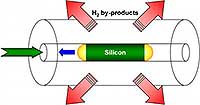 Single-crystal semiconductor wires integrated into microstructored optical wires. Credit: Penn State University
The development of the single-crystal device, which will be described in a paper to be published later this month in the journal Advanced Materials, builds on research reported in 2006, in which the team first combined optical fibers with polycrystalline and amorphous semiconductor materials in order to create an optical fiber that also has electronic characteristics. The group's latest finding -- that a single-crystal semiconductor also can be integrated into an optical fiber -- is expected to lead to even further improvements in the characteristics of optical fibers used in many areas of science and technology.
"For most applications, single-crystal semiconductor materials have better performance than polycrystalline and amorphous materials," said John Badding, associate professor of chemistry at Penn State. "We have now shown that our technique of encasing a single-crystal semiconductor within an optical fiber results in greater functionality of the optical fiber, as well."
The team used a high-pressure fluid-liquid-solid approach to build the crystal inside the fiber. First, the scientists deposited a tiny plug of gold inside the fiber by exposing a gold compound to laser light. Next, they introduced silane, a compound of silicon and hydrogen, in a stream of high-pressure helium. When the fiber was heated, the gold acted as a catalyst, decomposing the silane and thus allowing silicon to deposit as a single crystal behind the moving gold catalyst particle, forming a single-crystal wire inside the fiber.
"The key to joining two technologies lies not only in the materials, but also in how the functions are built in," said Pier Sazio, senior research fellow in the Optoelectronics Research Centre at the University of Southampton. "We were able to embed a nanostructured crystal into the hollow tube of an optical fiber to create a completely new type of composite device."
The research team sees potential to carry the application to the next level. "At present, we still have electrical switches at both ends of the optical fiber," said Badding. "If we can get to the point where the electrical signal never leaves the fiber, it will be faster and more efficient."