Dec 21 2008
Engineers at the University of Idaho have developed unique new technology that will be used in upcoming NASA missions that will study the Earth and Sun-Earth connection. Under the general guidance of a grant technical officer Pen-Shu Yeh, a senior engineer at NASA's Goddard Space Flight Center, Greenbelt, Md., the engineering team at the University of Idaho's (U-Idaho) Center for Advanced Microelectronics Biomolecular Research (CAMBR) located in Post Falls, Idaho, recently developed three advanced special purpose processors.
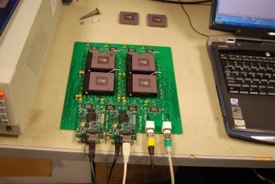 Compression chips mounted on a board at University of Idaho are ready for radiation testing.
These processors will be used in the Landsat Data Continuity Mission (LDCM) and the Magnetospheric Multiscale Mission (MMS) mission. Yeh lead the creation of an advanced data compression algorithm that will increase science data return for NASA missions. "She demonstrated that the algorithm is superior to existing technology for onboard applications." said Gary Maki, Principal Investigator on the U-Idaho team. A second algorithm, a channel coder, was created by Prof. Shu Lin of University of California at Davis, for protecting data fidelity in a communication channel. The data compression algorithm, adopted by the international Consultative Committee on Space Data Systems (CCSDS) in 2005, allows missions to precisely control compression factor, therefore the data rate from instruments.
"The algorithm is more than 50 times more complicated than the previous CCSDS compression standard," says Yeh. "However, this algorithm is much more versatile, but it does pose a great challenge for implementation." The channel coder algorithm, devised by one of the world's leading coding expert, Shu Lin, was created for high-speed space use under a set of requirements provided by another Goddard engineer, Wai Fong who also provided guidance in the technology development.
The algorithm is now being considered by the CCSDS as a new standard. The channel coder provides protection to data in the form of 'error-correction-codes' and thus improves communication channel quality. This new algorithm is shown to perform better than previous CCSDS standards. The team of specialized processor chip designers at U-Idaho were able to implement these difficult algorithms and create high speed versions suitable for various space missions.
They tested the processor chips in October. Aeroflex, a company in Colorado Springs is now testing for flight qualification. "We at NASA are extremely fortunate to have the U-Idaho team developing these chips from given algorithms," says Yeh. "The team's capability allows high-end specialized space processors to be developed at a budget level considered 'shoe-string' by industry standards. I hope other NASA centers and maybe other government agencies can benefit from this capability and the developed technology."
Generally speaking, two of the chips - the Discrete Wavelet Transformer and Bit Plane Encoder – compress data to be sent back to Earth. "If we didn't produce these chips, instruments on the MMS satellites would have to greatly reduce science data return or use an inferior technique with less performance," Yeh said. The third chip – the Low Density Parity Check encoder, adds redundancy information to data before it is transmitted to Earth. This allows for error corrections caused by signal degradation. A fourth chip, the previously developed lossless data compression chip called Universal Source Encoder for Space and the newly developed LDPC channel coder will be implemented in the LDCM mission. LDCM is the future of Landsat satellites.
It will continue to obtain valuable data and imagery to be used in agriculture, education, business, science, and government. The Landsat Program provides repetitive acquisition of medium resolution near-infrared and visible data of the Earth's surface on a global basis. The MMS will have four spacecraft acting in concert to measure the three-dimensional structure and motion of magnetic and electric fields around the Earth. MMS will determine the small-scale basic plasma processes which transport, accelerate and energize plasmas in thin boundary and current layers – and which control the structure and dynamics of the Earth's magnetosphere.
MMS will for the first time measure the 3-D structure and dynamics of the key magnetospheric boundary regions, from the subsolar magnetopause to the distant tail. Launch is planned for 2014. "Currently, this new technology is not available anywhere else in the world," Maki said.