Science fiction fans still have another two months of waiting for the new Star Trek movie, but fans of actual science can feast their eyes now on the first movie ever of carbon atoms moving along the edge of a graphene crystal. Given that graphene - single-layered sheets of carbon atoms arranged like chicken wire - may hold the key to the future of the electronics industry, the audience for this new science movie might also reach blockbuster proportions.
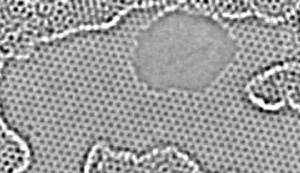 Picture shows the growth of a hole and the atomic edge reconstruction in a graphene sheet. An electron beam focused to a spot on the sheet blows out the exposed carbon atoms to make the hole. The carbon atoms then reposition themselves to find a stable configuration. Credit: National Center for Electron Microscopy
Researchers with the U.S. Department of Energy's Lawrence Berkeley National Laboratory (Berkeley Lab), working with TEAM 0.5, the world's most powerful transmission electron microscope, have made a movie that shows in real-time carbon atoms repositioning themselves around the edge of a hole that was punched into a graphene sheet. Viewers can observe how chemical bonds break and form as the suddenly volatile atoms are driven to find a stable configuration. This is the first ever live recording of the dynamics of carbon atoms in graphene.
"The atom-by-atom growth or shrinking of crystals is one of the most fundamental problems of solid state physics, but is especially critical for nanoscale systems where the addition or subtraction of even a single atom can have dramatic consequences for mechanical, optical, electronic, thermal and magnetic properties of the material," said physicist Alex Zettl who led this research. "The ability to see individual atoms move around in real time and to see how the atomic configuration evolves and influences system properties is somewhat akin to a biologist being able to watch as cells divide and a higher order structure with complex functionality evolves."
Zettl holds joint appointments with Berkeley Lab's Materials Sciences Division (MSD) and the Physics Department at the University of California (UC) Berkeley, where he is the director of the Center of Integrated Nanomechanical Systems. He is the principal author of a paper describing this work which appears in the March 27, 2009 issue of the journal Science. The paper is entitled, "Graphene at the Edge: Stability and Dynamics." Co-authoring this paper with Zettl were Çaglar Girit, Jannik Meyer, Rolf Erni, Marta Rossell, Christian Kisielowski, Li Yang, Cheol-Hwan Park, Michael Crommie, Marvin Cohen and Steven Louie.
In their paper, the authors credit the unique capabilities of TEAM 0.5 for making their movie possible. TEAM stands for Transmission Electron Aberration-corrected Microscope. The newest instrument at Berkeley Lab's National Center for Electron Microscopy (NCEM) - a DOE national user facility and the country's premier center for electron microscopy and microcharacterization - TEAM 0.5 is capable of producing images with half angstrom resolution, which is less than the diameter of a single hydrogen atom.
Said NCEM director Ulrich Dahmen of this achievement with TEAM 0.5, "The real-time observation of the movements of edge atoms could lead to a new level of understanding and control of nanomaterials. With further advances in electron-optical correctors and detectors it may become possible to increase the sensitivity and speed of such observations, and begin to see a live view of many other reactions at the atomic scale."
Rubbing graphene off the end of a pencil tip and suspending the specimen in an observation grid, Zettl and his colleagues used prolonged irradiation from TEAM 0.5's electron beam (set at 80 kV) to introduce a hole into the graphene's pristine hexagonal carbon lattice. Focusing the beam to a spot on the sheet blows out the exposed carbon atoms to create the hole. Since atoms at the edge of the hole are continually being ejected from the lattice by electrons from the beam the size of the hole grows. The researchers used the same TEAM 0.5 electron beam to record for analysis a movie showing the growth of the hole and the rearrangement of the carbon atoms.
"Atoms that lose their neighbors become highly volatile, and move around rapidly, continually repositioning themselves from one metastable configuration to the next," said Zettl. "Although configurations come and go, we found a zigzag configuration to be the most stable. It occurs more often and over longer length scales along the edge than the other most common configuration, which we called the armchair."
Understanding which of these atomic configurations is the most stable is one of the keys to predicting and controlling the stability of a device that utilizes graphene edges. The discovery of strong stability in the zigzag configuration is particularly promising news for the spintronic dreams of the computer industry.
Two years ago, co-authors Cohen and Louie, theorists who hold joint appointments with Berkeley Lab's Materials Sciences Division and UC Berkeley, calculated that nanoribbons of graphene can conduct a spin current and could therefore serve as the basis for nanosized spintronic devices. Spin, a quantum mechanical property arising from the magnetic field of a spinning electron, carries a directional value of either "up" or "down" that can be used to encode data in the 0s and 1s of the binary system. Spintronic devices promise to be smaller, faster and far more versatile than today's devices because - among other advantages - data storage does not disappear when the electric current stops.
Carbon atoms moving at the edge of a hole in graphene