At this week's Design, Automation + Test in Europe (DATE) conference, IMEC presents a new design strategy for brain implants, which it used to create a prototype multi-electrode stimulation + recording probe for deep-brain stimulation. With this development, IMEC highlights the opportunities in the healthcare market for design tool developers.
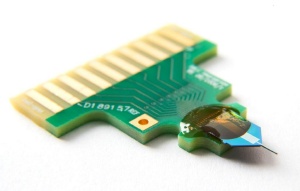
Brain implants for electrical stimulation of specific brain areas are used as a last-resort therapy for brain disorders such as Parkinson's disease, tremor, or obsessive-compulsive disorder. Today’s deep-brain stimulation probes use millimeter-size electrodes. These stimulate, in a highly unfocused way, a large area of the brain and have significant unwanted side effects.
Wolfgang Eberle, Senior Scientist and project manager at IMEC’s bioelectronics research group: “To have a more precise stimulation and recording, we need electrodes that are as small as individual brain cells (neurons). Such small electrodes can be made with semiconductor process technology, appropriate design tools, and advanced electronic signal processing. At DATE, we want to bring this message to the design community, showing the huge opportunities that the healthcare sector offers.”
IMEC’s design and modeling strategy allows developing advanced brain implants consisting of multiple electrodes enabling simultaneous stimulation and recording. This strategy was used to create prototype probes with 10 micrometer-size electrodes and various electrode topologies.
The design strategy relies on finite-element modeling of the electrical field distribution around the brain probe. This was done with the multi-physics simulation software COMSOL 3.4 and 3.5. The COMSOL tools also enabled investigating the mechanical properties of the probe during surgical insertion and the effects of temperature. The results indicate that adapting the penetration depth and field asymmetry allow steering the electrical field around the probe. This results in high-precision stimulation. Also key to the design approach is developing a mixed-signal compensation scheme enabling multi-electrode probes capable of stimulation as well as recording. This is needed to realize closed-loop systems.
These new design approaches open up possibilities for more effective stimulation with less side effects, reduced energy consumption due to focusing the stimulation current on the desired brain target, and closed-loop control adapting the stimulation based on the recorded effect.