Liquidia Technologies today presented data at the National Foundation of Infectious Disease (NFID) Annual Meeting which supports new insight into a technology that could provide more safe and effective vaccines for a wide variety of diseases. Results of the study show that the desired immune response elicited by a vaccine can be enhanced up to 10-fold when the vaccine protein is linked to nano-particles of a particular size and shape. The discovery may lead to a new generation of vaccines that could provide faster immunity to disease and potentially minimize the need for multiple vaccinations or "booster shots."
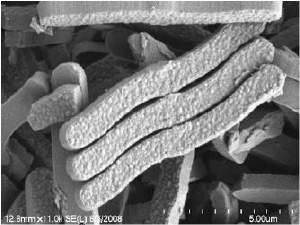 PRINT® particles mimicking the size and shape of bacteria may improve the safety and efficacy of vaccines.
“It has long been known that virus and bacteria come in a variety of sizes and shapes and that the human body responds very differently to each one of these disease causing agents,” said Joseph DeSimone, Founder of Liquidia Technologies and Chancellor’s Eminent Professor of Chemistry at University of North Carolina – Chapel Hill. “This data may help us better understand how to use the characteristics of naturally occurring pathogens to create vaccines that are more effective and require less product exposure for the patient.”
Current vaccination methods utilize weakened or deactivated pathogens (disease causing agents) to elicit an immune response in the body without the symptoms of the actual infection. Subsequently, if a person is exposed to others with that particular disease their immune system can quickly respond and more effectively fight off the infection. This study suggests that an even greater immune response may be generated when the same weakened pathogens are attached to extraordinarily small particles that are well tolerated by the body.
“The immune system is very sensitive to the size and shape of foreign bodies introduced into the body,” said Neal Fowler, CEO of Liquidia Technologies. “Having insight into the role of these characteristics when mounting an immune response is a very significant step toward finding safer and more effective ways of administering vaccines to patients.”
The particles used in this study were created using a proprietary method known as PRINT®, which stands for Particle Replication In Non-wetting Templates. The PRINT Platform leverages the precision of microelectronics to create rationally designed nanoparticles with absolute control over particle size, shape, composition and surface chemistry in a controlled and scalable manufacturing process. In developing particle technologies for vaccines, each of these variables can be optimized for a specific immunogenic response allowing for an unprecedented level of design control compared to other delivery systems. In addition to controlled co-delivery of antigens or other pharmacological agents that can increase or aid their effect, the PRINT platform allows the exploration of the impact of non-spherical particle shapes on biological response.