Carl Zeiss has launched a Dual Camera Module for its AxioVision image analysis software to improve the imaging of fast intracellular processes. The new software is aimed at life scientists, such as cell biologists, virologists and physiologists, and allows the simultaneous acquisition of images from two cameras and their synchronization within nanoseconds.
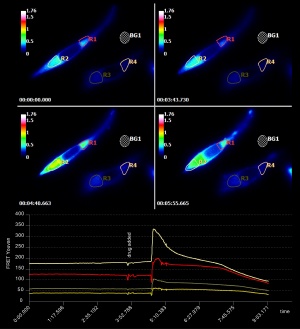 The Dual Camera module for the AxioVision image analysis software from Carl Zeiss permits the examination of fast intracellular processes with maximum resolution in both time and space.
Combined with two identical cameras, the Dual Camera Module will control all aspects of their operation and enable camera parameters, such as exposure time or contrast, to be set independently. Due to the simultaneous capture of two separate images, the software allows users to capture more images in any given timeframe. Furthermore, artifacts that can occur in the sequential capture of double-stained structures using a single camera are prevented, as are errors in ratiometric measurements of two emission channels.
The capture of two different wavelengths in two channels will be especially valuable in the measurement of emission ratio imaging (Indo-1), fast FRET examinations, and the imaging of cellular transport processes in cell cultures, tissues or organisms. It will also be an important asset in the simultaneous imaging of tissue and cell structures using infrared transmitted-light techniques, such as IR-DIC and fluorescence excitation. The latter is a key requirement for electrophysiological work in neurobiology.
The Dual Camera Module also eliminates the need to change filters or use emission filter wheels to visualize two dyes. Additionally, projecting two images on the sensor of a camera via optical adapters using Dual Camera does not sacrifice the field of view. The functionality of the AxioVision Physiology recording and analysis module, in particular, benefits from the possibilities provided by Dual Camera and it will aid live cell imaging studies when combined with the Cell Observer HS and Cell Observer SD microscope systems.