Michael Creutz, a physicist at the U.S. Department of Energy's Brookhaven National Laboratory, has received a Humboldt Research Award, which will allow him to spend up to one year working on a long-term research project with specialist colleagues at a research institution in Germany. The Humboldt Foundation grants up to 100 of the awards annually to researchers whose fundamental discoveries, new theories, or insights have had a significant impact on their own discipline and who are expected to continue producing cutting-edge achievements in the future.
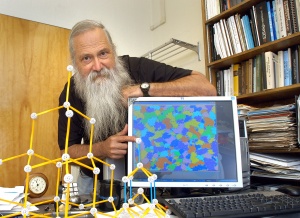 Michael Creutz
“Starting in the fall, I plan on spending several two-month periods at the Johannes Gutenberg University Mainz to pursue research for an expanded understanding of the properties of quarks,” Creutz said. “I am pleased to have this opportunity to interact with colleagues in Germany, who will provide a different way of thinking about my work. The experience will be very broadening and productive.”
Michael Creutz’s research is focused on quantum chromodynamics (QCD), a theory that describes the interactions of subnuclear particles. Specifically, Creutz first demonstrated that properties of QCD could be computed numerically on a four-dimensional lattice through computer-based calculations known as Monte Carlo techniques.
In one of the most cited papers of 1980, which was published in the journal Physical Review, Creutz provided strong numerical evidence that quarks cannot be isolated, thus confirming this conjectured property of QCD. He found that the force between widely separated quarks, which is equal to 14 tons, did not decrease as the quarks move farther apart.
With his colleagues in Germany, Creutz will study the interplay of the lattice with another complementary technique called chiral symmetry to gain further understanding of the physics of quarks. Creutz will investigate how certain quantum mechanical anomalies give rise to an apparent clash between these techniques and how this is resolved as the lattice becomes finer. Such information is important for physicists to interpret new findings in experiments at accelerators such as Brookhaven's Relativistic Heavy Ion Collider and the Large Hadron Collider at CERN, the European Organization for Nuclear Research.
Michael Creutz earned a B.S. in physics from the California Institute of Technology in 1966, and a Ph.D. in physics from Stanford University in 1970. He was a postdoctoral fellow at the Center for Theoretical Physics at the University of Maryland before he joined Brookhaven Lab in 1972 as an assistant physicist. He rose through the ranks to become a senior physicist in 1980.
A fellow of the American Physical Society (APS), Creutz received the APS’s Aneesur Rahman Prize for Computational Physics in 2000. He also received the Brookhaven Research & Development Award in 1991 and the Andrew Sobczk Memorial Lectureship from Clemson University in 1997. In 2008, he was honored with the Gian Carlo Wick Gold Medal Award from the World Federation of Scientists for outstanding contributions to particle physics.