Researchers at the National Institute of Standards and Technology (NIST) have discovered that a reduction in mechanical strain at the boundaries of crystal grains can significantly improve the performance of high-temperature superconductors (HTS). Their results* could lead to lower cost and significantly improved performance of superconductors in a wide variety of applications, such as power transmission, power grid reliability and advanced physics research.
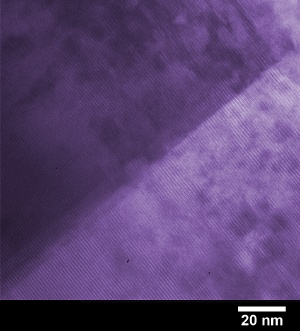 Electron microscope image of two superconducting thin films that meet at a 6 degree tilt boundary (the dark line running through the image). The numerous smaller lines that intersect the grain boundary at 90 degrees are the individual crystalline layers. The connection between the two films shows distortions in the superconducting layers, which severely limits current flow in these materials. Credit: F.J. Baca, U.S. Air Force Research Lab
One of the main challenges in developing long-length, high-quality HTS wires is to mitigate the effect of granularity on wire performance because grain boundaries are prone to block current flow. Dislocations—defects in the crystalline structure—that grow in number with increasing grain-boundary angle strongly reduce the superconducting crosssection of the grain boundary.
Switching to thin-film designs has led to great improvements in grain alignment and significantly improved performance in, for instance, yttrium-barium-copper-oxide (YBCO) coated conductors. But even in these highly aligned superconductor films grain boundaries still limit their performance. The effect of dislocations can further be mitigated by chemical doping of the grain boundaries—for instance by replacing some of the yttrium atoms with calcium—but it has been difficult to apply this technique to long wire lengths.
Although it is well known that dislocations cause part of the grain boundary crosssection to become non-superconducting, the effect of strain—which extends from the dislocations into the remaining superconducting bridges over the grain boundary—was previously unknown. NIST’s Danko van der Laan and his collaborators have found that this strain plays a key role in reducing current flow over grain boundaries in YBCO. Furthermore, when the strain was removed by applying compression to the grain boundaries, the superconducting properties improved dramatically.
The new understanding of the effects of strain on current flow in thin-film superconductors could significantly advance the development of these materials for practical applications and could lower their cost. Some of the most promising uses are in more efficient electrical transmission lines, which already have been successfully demonstrated by U.S. power companies, and increased electric power grid reliability. NIST has research programs in both these areas. Improved HTS thin-film conductors could also enable more powerful high-field particle accelerators and advanced cancer treatment facilities.
* D.C. van der Laan, T.J. Haugen and P.N. Barnes. Effect of compressive uni-axial strain on grain boundary critical current density in YBa2Cu3O7-d superconducting films, Physical Review Letters Accepted papers, June 9, 2009.