Miniature devices for trapping ions (electrically charged atoms) are common components in atomic clocks and quantum computing research. Now, a novel ion trap geometry demonstrated at the National Institute of Standards and Technology (NIST) could usher in a new generation of applications because the device holds promise as a stylus for sensing very small forces or as an interface for efficient transfer of individual light particles for quantum communications.
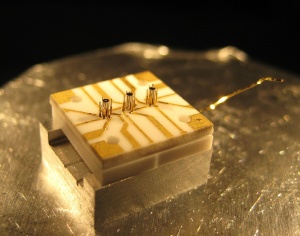 The NIST "stylus trap" can hold a single ion (electrically charged atom) above any of the three sets of concentric cylinders on the centerline. The device could be used as a stylus with a single atom "tip" for sensing very small forces or an interface for efficient transfer of individual light particles for quantum communications. Credit: Maiwald, NIST
The “stylus trap,” built by physicists from NIST and Germany’s University of Erlangen-Nuremberg, is described in Nature Physics.* It uses fairly standard techniques to cool ions with laser light and trap them with electromagnetic fields. But whereas in conventional ion traps, the ions are surrounded by the trapping electrodes, in the stylus trap a single ion is captured above the tip of a set of steel electrodes, forming a point-like probe. The open trap geometry allows unprecedented access to the trapped ion, and the electrodes can be maneuvered close to surfaces. The researchers theoretically modeled and then built several different versions of the trap and characterized them using single magnesium ions.
The new trap, if used to measure forces with the ion as a stylus probe tip, is about one million times more sensitive than an atomic force microscope using a cantilever as a sensor because the ion is lighter in mass and reacts more strongly to small forces. In addition, ions offer combined sensitivity to both electric and magnetic fields or other force fields, producing a more versatile sensor than, for example, neutral atoms or quantum dots. By either scanning the ion trap near a surface or moving a sample near the trap, a user could map out the near-surface electric and magnetic fields. The ion is extremely sensitive to electric fields oscillating at between approximately 100 kilohertz and 10 megahertz.
The new trap also might be placed in the focus of a parabolic (cone-shaped) mirror so that light beams could be focused directly on the ion. Under the right conditions, single photons, particles of light, could be transferred between an optical fiber and the single ion with close to 95 percent efficiency. Efficient atom-fiber interfaces are crucial in long-distance quantum key cryptography (QKD), the best method known for protecting the privacy of a communications channel. In quantum computing research, fluorescent light emitted by ions could be collected with similar efficiency as a read-out signal. The new trap also could be used to compare heating rates of different electrode surfaces, a rapid approach to investigating a long-standing problem in the design of ion-trap quantum computers.
Research on the stylus trap was supported by the Intelligence Advanced Research Projects Activity.
* R. Maiwald, D. Leibfried, J. Britton, J.C. Bergquist, G. Leuchs, and D.J. Wineland. 2009. Stylus ion trap for enhanced access and sensing. Nature Physics, published online June 28.