What do the mystery of how proteins fold, the unexpected behavior of nanoparticles, and the key to making hydrogen fuel cells have in common? All can be investigated with beams of slow-moving neutrons-and scientists at the National Institute of Standards and Technology (NIST) took a week this summer to teach the next generation of scientists how to use these beams to explore innovative materials.
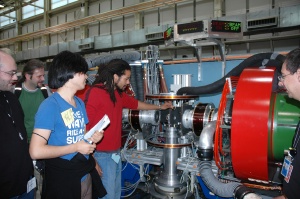 Khiza Mazwi, a student from the University of Southern California, replaces a sample in the spin echo spectrometer while other participants in the NCNR summer school look on. Credit: Boutin, NIST
Thirty-six students came to NIST’s Center for Neutron Research (NCNR) to cut their teeth on some of the world’s finest tools for probing the intricacies of small, valuable materials. The NCNR Summer School, now in its 15th year, provides undergraduate and graduate students from the United States and abroad with hands-on experiences with the NCNR’s sensing equipment, which harnesses cold, or slow, neutrons to illuminate the inner workings of objects just a few nanometers across—from proteins important since life began to the latest creations of nanotechnology. Jointly funded by NIST and the National Science Foundation, the school’s organizers aim to inspire as much as enlighten.
“We want future scientists to see what these tools can do for their research, whatever field they happen to be in,” says the NCNR’s Dan Neumann, “and it works. More than 70 percent come back to do experiments at NIST, both before and after they earn their doctorates.”
The school alternates between two different courses: this year introduces students to inelastic scattering tools that reveal how very small objects move, and next year will concentrate on low angle scattering, which is useful for exploring the structure of larger objects from 1 to more than 1,000 nanometers wide. Neumann says the alternation helps students focus on their interests.
“We have lots of different instruments, and we want our students to experience what’s useful for their own research,” Neumann says. “They each get several hours of hands-on instruction on three instruments best suited to their research interest.”
Many of this year’s attendees, who are primarily budding engineers and materials scientists, say that the amalgam of inspiration and training on novel equipment has encouraged them to incorporate neutron scattering into their own future efforts. Adam Holferty, who studies chemical engineering at the University of Missouri, says he hopes to use his new knowledge this fall.
“I’m working on ways to deliver drugs by using nanoparticles that break open when you put a magnetic field on them,” he says. “I’m betting neutron beams will be useful in exploring the particles’ properties, and now I might be able to get in on some scattering experiments back at the MU’s research reactor. It’s one thing knowing theory, but knowing how to apply it in practice is a big help.”