The Primo Star iLED microscope from Carl Zeiss is now available with three additional fluorescence attachments that allow users to work with different dyes such as FITC, Dapi and Rhodamine/Cy 3. This permits the use of the LED-based microscope for single fluorescence applications in training, routine procedures and basic research. It is particularly robust and easy to use, and features an outstanding price-performance ratio, to which the long-lasting, inexpensive and energy-saving LED light source makes a valuable contribution.
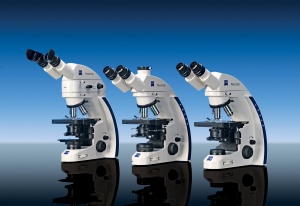 The LED-based Primo Star iLED from Carl Zeiss provides key benefits for simple fluorescence applications in training, routine procedures and basic research.
For training in particular, fluorescence excitation through LED illumination is beneficial as there are no warm-up or cool-down times unlike fluorescence excitation using mercury vapor lamps. Furthermore, the excitation lamps no longer need to be readjusted, enabling the user to start working as soon as the light source is turned on. The iLED fluorescence attachment comes with practical eyecups, making it possible to perform fluorescence microscopy without a darkroom—in an auditorium, for example. A lever is used to alternate between brightfield and fluorescence microscopy.
The Primo Star iLED was originally developed together with FIND, the Foundation for Innovative New Diagnostics, for the fast and reliable LED fluorescence based testing of tuberculosis and has been on the market since October 2008.
All Primo Star basic packages can be retrofitted with a total of four iLED fluorescence attachments. This also applies to the systems with phase contrast objectives and systems for applications in which a cover slip (D=0) is not used such as in the fast diagnosis of smears and in the diagnosis of tuberculosis.