The explosion in the number of new fluorescent dyes has opened up exciting new opportunities for life science researchers. However, each requires the microscope system to be equipped with an appropriate excitation laser, a limitation that has greatly restricted their adoption.
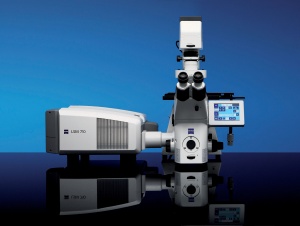 The LSM 710 microscope system with the In Tune laser system from Carl Zeiss permits the free selection of excitation laser lines in the 488 nm to 640 nm range.
According to Carl Zeiss, the answer is the new In Tune laser system, which offers free selection of laser lines in the range 488 nm to 640 nm. Together with the LSM 710 laser scanning microscope, In Tune enables cell biologists, physiologists and researchers in biology, medicine and biophysics to perform novel fluorescence measurements for the first time. Whatever the excitation wavelength required, In Tune matches the dye perfectly to enable their use in intensity or lifetime imaging experiments.
The choice of fluorescent dyes is unrestricted as In Tune can be used alongside other system lasers, from near UV to far red. This is particularly important for FRET (Förster Resonance Energy Transfer) as In Tune allows the unrestricted use of new dye combinations in the green-red spectral range. With its 40 MHz pulse repetition rate In Tune is also an ideal source of excitation for FLIM (Fluorescence Lifetime Imaging Microscopy) experimentation.
In Tune is as stable and reliable as standard gas or diode lasers, offering a comparably low noise level that does not degrade the high image quality of the LSM 710. New or existing LSM 710 or LSM 710 NLO systems can be equipped with In Tune and control of the new laser is integrated into the Zeiss ZEN software where ‘Smart Setup’ takes care of the LSM settings for excitation and detection.