Even Albert Einstein might have been impressed. His theory of general relativity, which describes how the gravity of a massive object, such as a star, can curve space and time, has been successfully used to predict such astronomical observations as the bending of starlight by the sun, small shifts in the orbit of the planet Mercury and the phenomenon known as gravitational lensing. Now, however, it may soon be possible to study the effects of general relativity in bench-top laboratory experiments.
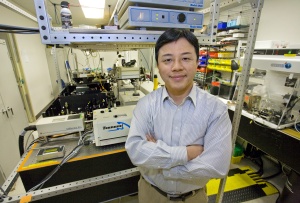 Xiang Zhang has been one of the pioneers in the creation of artificial optical materials and their applications to such phenomena as negative refraction, electromagnetic invisibility devices and microscopy with super-resolution. (Photo by Roy Kaltschmidt, Berkeley Lab Public Affairs)
Xiang Zhang, a faculty scientist with the U.S. Department of Energy's Lawrence Berkeley National Laboratory (Berkeley Lab) and professor at the University of California Berkeley, lead a study in which it was determined that the interactions of light and matter with spacetime, as predicted by general relativity, can be studied using the new breed of artificial optical materials that feature extraordinary abilities to bend light and other forms of electromagnetic radiation.
"We propose a link between the newly emerged field of artificial optical materials to that of celestial mechanics, thus opening a new possibility to investigate astronomical phenomena in a table-top laboratory setting," says Zhang. "We have introduced a new class of specially designed optical media that can mimic the periodic, quasi-periodic and chaotic motions observed in celestial objects that have been subjected to complex gravitational fields."
A paper describing this work is now available on-line in the journal Nature Physics. The paper is titled: "Mimicking Celestial Mechanics in Metamaterials." Co-authoring it with Zhang were his post-doctoral students Dentcho Genov and Shuang Zhang.
Zhang, a principal investigator with Berkeley Lab's Materials Sciences Division and director of UC Berkeley's Nano-scale Science and Engineering Center, has been one of the pioneers in the creation of artificial optical materials. Last year, he and his research group made headlines when they fashioned unique metamaterials - composites of metals and dielectrics - that were able to bend light backwards, a property known as a negative refraction that is unprecedented in nature. More recently, he and his group fashioned a "carpet cloak" from nanostructured silicon that concealed the presence of objects placed under it from optical detection. These efforts not only suggested that true invisibility materials are within reach, Zhang said, but also represented a major step towards transformation optics that would "open the door to manipulating light at will."
Now he and his research group have demonstrated that a new class of metamaterials called "continuous-index photon traps" or CIPTs can serve as broadband and radiation-free "perfect" optical cavities. As such, CIPTs can control, slow and trap light in a manner similar to such celestial phenomena as black holes, strange attractors and gravitational lenses. This equivalence between the motion of the stars in curved spacetime and propagation of the light in optical metamaterials engineered in a laboratory is referred to as the "optical-mechanical analogy."
Zhang says that such specially designed metamaterials can be valuable tools for studying the motion of massive celestial bodies in gravitational potentials under a controlled laboratory environment. Observations of such celestial phenomena by astronomers can sometimes take a century of waiting.
"If we twist our optical metamaterial space into new coordinates, the light that travels in straight lines in real space will be curved in the twisted space of our transformational optics," says Zhang. "This is very similar to what happens to starlight when it moves through a gravitational potential and experiences curved spacetime. This analogue between classic electromagnetism and general relativity, may enable us to use optical metamaterials to study relativity phenomena such as gravitational lens."
In their demonstration studies, the team showed a composite of air and the dielectric Gallium Indium Arsenide Phosphide (GaInAsP). This material provided operation at the infrared spectral range and featured a high refractive index with low absorptions.
In their paper, Zhang and his coauthors cite as a particularly intriguing prospect for applying artificial optical materials to the optical-mechanical analogy the study of the phenomenon known as chaos. The onset of chaos in dynamic systems is one of the most fascinating problems in science and is observed in areas as diverse as molecular motion, population dynamics and optics. In particular, a planet around a star can undergo chaotic motion if a perturbation, such as another large planet, is present. However, owing to the large spatial distances between the celestial bodies, and the long periods involved in the study of their dynamics, the direct observation of chaotic planetary motion has been a challenge. The use of the optical-mechanical analogy may enable such studies to be accomplished in a bench-top laboratory setting on demand.
"Unlike astronomers, we will not have to wait 100 years to get experimental results," Zhang says.
This research was supported by the U.S. Army Research Office and by the National Science Foundation which funds the UC Berkeley Nano-scale Science and Engineering Center.