Ytterbium was discovered in 1878, but until it recently became useful in atomic clocks, the soft metal rarely made the news. Now ytterbium has a new claim to scientific fame. Measurements with ytterbium-174, an isotope with 70 protons and 104 neutrons, have shown the largest effects of parity violation in an atom ever observed - a hundred times larger than the most precise measurements made so far, with the element cesium.
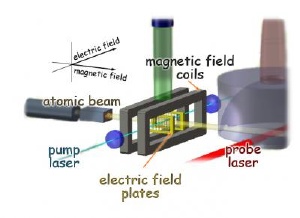 An atomic beam of ytterbium is generated in the oven at left, then passed through a chamber with magnetic and electric fields arranged at right angles -- the magnetic field colinear with the atomic beam, and the electric field colinear with a laser beam that excites a "forbidden" electron-energy transition. Weak interactions between electron and nucleus contribute to the forbidden transition. Credit: Lawrence Berkeley National Laboratory
"Parity" assumes that, on the atomic scale, nature behaves identically when left and right are reversed: interactions that are otherwise the same but whose spatial configurations are switched, as if seen in a mirror, ought to be indistinguishable. Sounds like common sense but, remarkably, this isn't always the case.
"It's the weak force that allows parity violation," says Dmitry Budker, who led the research team. Budker is a member of the Nuclear Science Division at the U.S. Department of Energy's Lawrence Berkeley National Laboratory and a professor of physics at the University of California at Berkeley.
Of the four forces of nature - strong, electromagnetic, weak, and gravitational - the extremely short-range weak force was the last to be discovered. Neutrinos, having no electric charge, are immune to electromagnetism and only interact through the weak force. The weak force also has the startling ability to change the flavor of quarks, and to change protons into neutrons and vice versa.
Violating parity - neutrons and the weak force
Protons on their own last forever, apparently, but a free neutron falls apart in about 15 minutes; it turns into a proton by emitting an electron and an antineutrino, a process called beta decay. What makes beta decay possible is the weak force.
Scientists long assumed that nature, on the atomic scale, was symmetrical. It would look the same not only if left and right were reversed but also if the electrical charges of particles involved in an interaction were reversed, or even if the whole process ran backwards in time. Charge conjugation is written C, parity P, and time T; nature was thought to be C invariant, P invariant, and T invariant.
In 1957 researchers realized that the weak force didn't play by the rules. When certain kinds of nuclei such as cobalt-60 are placed in a magnetic field to polarize them - line them up - and then allowed to undergo beta decay, they are more likely to emit electrons from their south poles than from their north poles.
This was the first demonstration of parity violation. Before the 1957 cobalt-60 experiment, renowned physicist Richard Feynman had said that if P violation were true - which he doubted - something long thought impossible would be possible after all: "There would be a way to distinguish right from left."
It's now apparent that many atoms exhibit parity violation, although it is not easy to detect. P violation has been measured with the greatest accuracy in cesium atoms, which have 55 protons and 78 neutrons in the nucleus, by using optical methods to observe the effect when atomic electrons are excited to higher energy levels.
The Berkeley researchers designed their own apparatus to detect the much larger parity violation predicted for ytterbium. In their experiment, ytterbium metal is heated to 500 degrees Celsius to produce a beam of atoms, which is sent through a chamber where magnetic and electric fields are oriented at right angles to each other. Inside the chamber the ytterbium atoms are hit by a laser beam, tuned to excite some of their electrons to higher energy states via a "forbidden" (highly unlikely) transition. The electrons then relax to lower energies along different pathways.
Weak interactions between the electron and the nucleus - plus weak interactions within the nucleus of the atom - act to mix some of the electron energy states together, making a small contribution to the forbidden transition. But other, more ordinary electromagnetic processes, which involve apparatus imperfections, also mix the states and blur the signal. The purpose of the chamber's magnetic and electric fields is to amplify the parity-violation effect and to remove or identify these spurious electromagnetic effects.
Upon analyzing their data, the researchers found a clear signal for atomic parity violations, 100 times larger than the similar signal for cesium. With refinements to their experiment, the strength and clarity of the ytterbium signal promise significant advances in the study of weak forces in the nucleus.
Watching the weak force at work
The Budker group's experiments are expected to expose how the weak charge changes in different isotopes of ytterbium, whose nuclei have the same number of protons but different numbers of neutrons, and will reveal how weak currents flow within these nuclei.
The results will also help explain how the neutrons in the nuclei of heavy atoms are distributed, including whether a "skin" of neutrons surrounds the protons in the center, as suggested by many nuclear models.
He adds, "At a small level, the measured atomic parity violation effect depends on how the neutrons are distributed within the nucleus - specifically, their mean square radius. The mean square radius of the protons is well known, but this will be the first evidence of its kind for neutron distribution."
Measurements of parity violation in ytterbium may also reveal "anapole moments" in the outer shell of neutrons in the nucleus (valence neutrons). As predicted by the Russian physicist Yakov Zel'dovich, these electric currents are induced by the weak interaction and circulate within the nucleus like the currents inside the toroidal winding of a tokamak; they have been observed in the valence protons of cesium but not yet in valence neutrons.
Eventually the experiments will lead to sensitive tests of the Standard Model - the theory that, although known to be incomplete, still best describes the interactions of all the subatomic particles so far observed.
"So far, the most precise data about the Standard Model has come from high-energy colliders," says Budker. "The carriers of the weak force, the W and Z bosons, were discovered at CERN by colliding protons and antiprotons, a 'high-momentum-transfer' regime. Atomic parity violation tests of the Standard Model are very different - they're in the low-momentum-transfer regime and are complementary to high-energy tests."
Since 1957, when Zel'dovich first suggested seeking atomic variation in atoms by optical means, researchers have come ever closer to learning how the weak force works in atoms. Parity violation has been detected in many atoms, and its predicted effects, such as anapole moments in the valence protons of cesium, have been seen with ever-increasing clarity. With their new experimental techniques and the observation of a large atomic parity violation in ytterbium, Dmitry Budker and his colleagues have achieved a new landmark, moving closer to fundamental revelations about our asymmetric universe on the atomic scale.