The sandwich recipe recently concocted by scientists working at the National Institute of Standards and Technology (NIST) may prove tasty for computer chip designers, who have long had an appetite for molecule-sized electronic components - but no clear way to satisfy it until now.
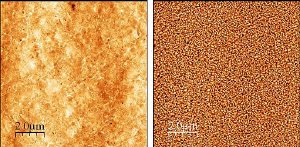 The flip-chip lamination method creates an ultra-smooth gold surface (left), which allows the organic molecules to form a thin yet even layer between the gold and silicon. Gold surfaces created by other methods are substantially rougher (right), and would result in many of the molecular switches either being smashed or not contacting the silicon. Credit: Coll Bau, NIST
The research team, which includes collaborators from the University of Maryland, has found a simple method of sandwiching organic molecules between silicon and metal, two materials fundamental to electronic components. By doing so, the team may have overcome one of the principal obstacles in creating switches made from individual molecules, which represent perhaps the ultimate in miniaturization for the electronics industry.
The idea of using molecules as switches has been around for years, carrying the promise of components that can be produced cheaply in huge numbers, perform faster as a group than their larger silicon brethren, and use only a tiny fraction of their energy. But although there has been progress in creating the switching molecules themselves, the overall concept has been stuck on drawing boards in large part because organic molecules are delicate and tend to be damaged irreparably when subjected to one particularly stressful step in the chip-building process: attaching them to electrical contacts.
Metal forms many of these contacts in chip circuits, but getting metal onto a chip involves heating it until it evaporates, then allowing it to condense on the silicon. “Imagine what hot steam would do to your arm,” says Mariona Coll Bau, a materials scientist at NIST. “Evaporated metal is much hotter, and organic switching molecules are very fragile—they can’t stand the heat.”
Coll Bau’s team, however, found a way to cool the kitchen. They cover a surface with a non-stick material before condensing gold on top of it, allowing the metal to cool to an ultra-smooth surface. They then laminate the gold surface with the plastic used in overhead transparencies. The non-stick layer allows them to remove the laminated gold from the surface as easily as peeling off plastic wrap. Adding the organic molecules then is comparatively simple: attach the molecules to the gold and then flip the whole assembly onto a silicon base, with the organic molecules sandwiched neatly inside—and intact.
Though scientists have attempted to make sandwiches of this sort before, Coll Bau says their first-ever use of an imprinting machine finally made it possible to assemble the ingredients effectively. “The machine allows us to press the three layers together so the organic molecules contact both the silicon and gold, but without smashing or otherwise degrading them,” she says.
Coll Bau adds that “flip-chip lamination,” as the team calls it, could lead to applications beyond chip design, including biosensors, which depend on the organic and electronic worlds interacting. “The technique may prove useful as a fabrication paradigm,” she says. “It’s hard to make small things, and this might be an easier way to make them.”
* M. Coll, L.H. Miller, L.J. Richter, D.R. Hines, O.D. Jurchescu, N. Gergel-Hackett, C. Richter and C.A. Hacker. Formation of silicon-based molecular electronic structures using flip-chip lamination. Journal of the American Chemical Society, Aug. 11, 2009 (online publication), DOI 10.1021/ja901646j.