The U.S. Department of Energy's (DOE) Argonne National Laboratory has received an additional $29.1 million in DOE Office of Science (SC) funding under the American Recovery and Reinvestment Act for a range of improvements and upgrades to major scientific facilities and other projects.
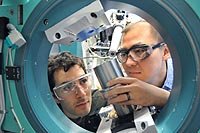 University of Chicago scientist Rafael Jaramillo and Argonne scientist Yejun Feng study the element chromium at the Advanced Photon Source, one of the Argonne facilities to be upgraded with funds from the Recovery Act.
The new funds come in addition to an earlier $15.1 million in Recovery Act funds provided for laboratory infrastructure modernization and $99 million in Recovery Act money provided by DOE's Office of Environmental Management for clean-up and remediation of legacy nuclear waste and facilities. The new funds bring Argonne’s total Recovery Act funding to date to more than $140 million.
"These new initiatives will help to create new jobs while allowing the U.S. to maintain its scientific leadership and economic competitiveness," said Energy Secretary Steven Chu. "The projects provide vital funding and new tools for research aimed at strengthening America’s energy security and tackling some of science’s toughest challenges."
Approximately $7.9 million will be used to upgrade equipment and acquire and install new detectors at the Advanced Photon Source (APS). The APS is a national synchrotron X-ray research facility supported by SC’s Office of Basic Energy Sciences. The APS provides the brightest X-ray beams in the Western Hemisphere and is used annually by nearly 3,500 scientists conducting advanced research in energy, materials science and other fields.
About $8.9 million of the Recovery Act funds will be used for upgrades at the Argonne Tandem Linac Accelerator System (ATLAS), a national user facility supported by the SC’s Office of Nuclear Physics (NP). ATLAS is a superconducting linear accelerator for heavy ions used by scientists to study the atomic nucleus and to understand the processes by which heavier elements—those with an atomic number greater than iron—are formed within stars.
In addition, the new Recovery Act funding includes the following:
- $3.8 million for equipment upgrades at Argonne’s Center for Nanoscale Materials, one of five Nanoscale Science Research Centers supported by SC’s Office of Basic Energy Sciences and located at national laboratories around the nation;
- $3.8 million for advanced research on particle detector technology, supported by SC’s Office of High Energy Physics;
- $220,000 for NP’s U.S. Nuclear Data Program to enhance the program’s efforts to compile, evaluate and disseminate experimental nuclear data for use in basic research and as a resource for a variety of applied programs such as reactor technology and national security.
Finally, Argonne has been allocated $4.5 million in Recovery Act funds from Pacific Northwest National Laboratory, part of $60 million provided to upgrade equipment for the Atmospheric Radiation Measurement Climate Research Facility (ACRF). The funds will be used to improve observational capabilities related to cloud and aerosol properties to study the critical role that these phenomena play in regional climate and atmospheric circulation changes. The ACRF, supported by SC’s Office of Biological and Environmental Research, is a collaboration of nine national laboratories, including Argonne.