Today, at IEEE EMB Conference in Minneapolis, Minnesota (USA), IMEC, a world-leading independent research center in nanoelectronics and nanotechnology, and its research affiliate Holst Centre present the clinical validation of a wireless sleep staging system. The miniaturized wireless system allows patients to wear the device in the comfort of their home, thus enabling early screening of abnormal sleep profiles outside clinics. The sleep staging system has been validated in the sleep laboratory at the University Hospital Center (CHU) in Charleroi, André Vésale Hospital (Belgium), against a commercially available reference system. With this validation, the technology is ready for product development at industry opening new perspectives for remote and comfortable sleep monitoring.
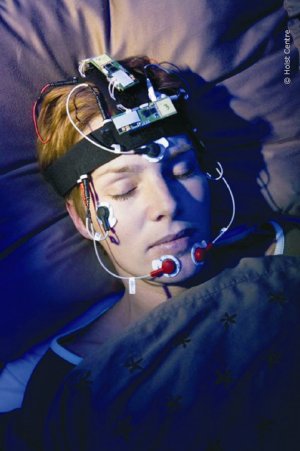 Caption: Wireless sleep monitoring for enhanced patient comfort.
Sleep disorder is a major health problem. 10% of the population of the U.S. is affected by sleep apneas, and 1 billion people worldwide experience some kind of chronic nasal congestion during sleep. IMEC’s wireless sleep staging system which is light weight, wearable and miniaturized can drastically increase the comfort of sleep disorders tests. The system consists of a head band with three sensor nodes measuring 2 EEG-channels (electroencephalogram) to monitor the brain activity, 2 EOG-channels (electro-oculogram) to monitor the eye activity and 1 EMG-channel (electromyogram) to monitor the chin muscle activity. These 5 signals provide the required information for sleep staging according to the Rechtschaffen and Kales standard. The sensor nodes integrate IMEC’s proprietary ultra-low power biopotential read-out ASIC (application-specific integrated circuit) to amplify and filter the 5 different ExG signals. The measured ExG signals are wirelessly transmitted to the recording computer. No additional wires from the head to the body or from the head to the recording device are needed, making the system comfortable to wear. The system is optimized for low power resulting in 12 hours autonomy.
The system has been validated in a controlled clinical environment and benchmarked with state-of-the-art ambulatory monitoring equipment. 12 healthy volunteers were enrolled in the study, and were monitored for a complete night using the wireless and the reference systems set-up in parallel. At the end of the study, the signals were given to a sleep expert for blind scoring, leading to two hypnograms for each subject. From the hypnograms, sleep statistics such as percentage of sleep time in each stage were deducted, and compared for the two systems. Hypnograms were also compared directly for similarity. The analysis proved the potential of wireless sleep staging systems to replace the current monitoring systems.
Within the Human++ program, IMEC and Holst Centre aim to develop solutions for an efficient and better healthcare. Wireless sensor nodes in intelligent body area networks may provide more comfortable healthcare systems by enabling home monitoring of patients. Home monitoring does not only increase the comfort of the patient, it is also a cost-efficient solution for expensive and time-consuming monitoring in hospitals. Moreover, wireless monitoring systems provide more natural daily life monitoring results. Industry can get access to the technology by joining the Human++ program as research partner or by licensing agreements for further product development.
Posted September 2ndt, 2009