At the Photomask Technology Conference 2009 in Monterey/CA Carl Zeiss introduces the next generation of their actinic AIMS™ mask qualification system. AIMS™ 32-193i emulates the imaging of photomasks with leading-edge 193nm immersion scanners for the 32nm node and beyond. The first delivery to a leading edge customer is scheduled for September 2009.
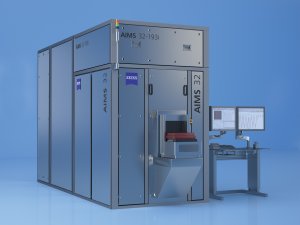 Actinic Mask Qualification System AIMS 32-193i.
The Aerial Image Measurement Technology from Carl Zeiss has been significantly advanced to enable accurate emulation of 32nm lithography techniques such as Double Patterning Technology, Source Mask Optimization and Computational Lithography.
Complex mask designs together with tighter CD specifications result in new challenges for photomask qualification with respect to repeatability and image quality. The AIMS™ 32-193i has been specifically designed for a CD repeatability specification below 0.25nm at wafer level equivalent to 1.00nm at mask level. “Based on the broad expertise of Carl Zeiss with scanner lens technologies we introduced a new LITO™ grade optics at AIMS™ 32-193i ensuring scanner- like imaging performance” said Dr. Oliver Kienzle, Managing Director of Carl Zeiss Semiconductor Metrology Systems division. “The system now includes interferometric stage technology for further accuracy in mask positioning.”
An advanced illumination system allows the emulation of all kinds of 193nm illumination settings. For the first time in AIMS™ history variable transmission in the illumination pupil is now available with AIMS™ 32-193i. Whilst previous AIMS™ generations were limited to a binary intensity distribution by geometric sigma aperture description the illumination scheme can now be defined with a varying grey-scale intensity as in the most advanced scanners. Such illumination schemes can be flexibly adjusted to different intensity distributions within the pupil.
Thus, the AIMS™ 32-193i enables accurate mask defect disposition and repair qualification for 32nm masks and ensures the introduction of upcoming lithography technologies such as Double Patterning, Computational Lithography (Inverse Litho Technology) and Source Mask Optimization (SMO).