Carl Zeiss has developed the DirectFRAP imaging system for all microscope users in cell biology and molecular genetics who examine processes in living cells on the basis of fluorescence-labeled proteins. Thanks to its operating principle and the photomanipulation in the wide field, DirectFRAP opens up the possibility of also studying highly dynamic processes in the cell and receiving detailed image information at the same time. It can be used on the Axio Observer microscope system from Carl Zeiss and allows the photomanipulation of a region of interest (ROI) in the specimen with laser light and the direct observation of the subsequent processes.
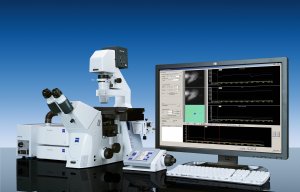 The DirectFRAP imaging system from Carl Zeiss.
All versions of photomanipulation are possible: bleaching of GFP, photoactivation of PA-GFP, conversion of Dendra, reversible on/off switching of Dronpa, and others. Laser pulse control and data acquisition are performed by the ZEISS AxioVision software.
The extremely short pulse times of DirectFRAP and the benefits of widefield microscopy such as short exposure times and larger observation field for fast processes offer optimal conditions for highly dynamic experiments like the examination of the interaction of proteins with macromolecules in the cell. The time sequence of the processes is clearly resolved.
The diaphragm options enable a high level of flexibility during experiments. This permits the use of DirectFRAP for answering dynamics-related questions or for the manipulation of fine cell structures. For this purpose, a broad spectrum of geometric ROI shapes is available on a diaphragm wheel in the slider for DirectFRAP. In addition to constant laser intensity when the diaphragm size is changed, the main benefit of the principle is the simultaneous manipulation of all points of the ROI.
DirectFRAP can be optionally used with other Carl Zeiss imaging systems such as Laser TIRF 3 or Cell Observer SD (Spinning Disc). System combinations allow the observation of processes in only one Z plane and are ideal, for example, for the isolated examination of small cell structures. The same lasers can be used simultaneously for DirectFRAP and Laser TIRF 3 or Cell Observer SD.
DirectFRAP helps to record dynamic processes in the cell. Changes in these processes over time can also be recognized in detail. Reactions of the cell can be examined in detail, for example. Fast, cellular processes become transparent.