With the LSM 780, Carl Zeiss is now adding a new member to its family of LSM 7 laser scanning microscopes. The use of the new GaAsP detector technology has almost doubled the sensitivity of the currently leading LSM 710. Cell biologists and neurobiologists can now visualize weakly fluorescent or bleach-sensitive specimens and specimens with fine structures more quickly and with higher image quality. The higher quantum efficiency of the new detectors makes it possible for the LSM 780 to also image specimens which could not be satisfactorily examined in the past, such as sensitive and weakly stained yeast cells.
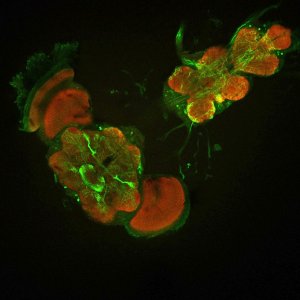 Image of the nerve system of the fruit fly with the LSM 780 laser scanning microscope from Carl Zeiss. Double staining with anti-GFP Alexa 488 (neurons) and NC82 Alexa 568 (synapses).
To make the GaAsP detector technology available to a wide range of users, it will be offered in three versions: as an internal spectral 32-channel detector in the LSM 780 laser scanning microscope, as a detector upgrade for existing LSM 710 systems and as the external LSM BiG upgrade module. All versions of the 32-channel GaAsP array permit traditional spectral imaging, photon counting with maximum sensitivity, and single molecule visualization through fluorescence correlation spectroscopy (FCS) with one to six signal channels.
With the universal LSM BiG module, the GaAsP technology can be used for further imaging modes. For multiphoton microscopy with the LSM 780 NLO and 710 NLO systems, the LSM BiG significantly improves non-descanned detection. While in the past several specialized detectors were required for imaging, multiphoton examination and FCS, the GaAsP technology of the LSM BiG makes it possible for all applications to be carried out with one universal module—with better image quality and faster image capture.
The 64-Bit ZEN 2010 software of the LSM 780 contains two new functions which are also available for the LSM 710 and LSM 710 NLO systems.
The OSCiscan function with Online Scanner Calibration allows higher speeds without compromise. Frames of 512 x 512 pixels can now be visualized with a speed of 8 frames a second while, for example, 250 frames a second are possible with image sizes of 512 x 16 pixels.
The ROI-HDR (High Dynamic Range Imaging) function enables intelligent enhancement of the image dynamics. The bright and dark areas of the specimen are scanned with individual and adapted acquisition settings, ensuring that optimal imaging fidelity is achieved for all parts of a specimen (e.g. nerve cells).
Its availability for the Axio Imager, Axio Examiner and Axio Observer microscope platforms allow the LSM 780 to meet user requests for upgrading possibilities and versatility. It can be delivered with all laser options of the LSM 710, such as NLO and the flexible InTune laser. Upgrades of current LSM 710 systems to the GaAsP technology of the LSM 780 are possible. Both systems can be combined with the new ELYRA P.1 and ELYRA PS.1 units for superresolution microscopy beyond the diffraction limit.