The Center for Nanoscale Materials (CNM) at the U.S. Department of Energy's (DOE) Argonne National Laboratory dedicated its new scanning probing microscopy building recently during its annual users conference. The new building will house a new scanning probe microscope that measures spin-polarized electrons on surfaces.
"The spin-polarized scanning probing microscope (LT-SPM) is a wonderful addition to the many tools available to researchers at the CNM," said interim CNM director Derrick Mancini. "Nanomagnetism is a burgeoning field, and the LT-SPM will provide the most cutting-edge technology for this research."
Nanomagnetism research using the LT-SPM may lead to more energy-efficient motors, advanced information storage, processing prototype devices, advanced medical therapy and biomagnetic sensing concepts. The LT-SPM is a multi-functional scanning probe microscope devoted to the high-resolution properties of spin-polarized surfaces at high magnetic fields (9 T) and low temperatures (4.2 K). This state-of-the-art instrument expands the CNM programs in nanomagnetism and nanoferroelectrics.
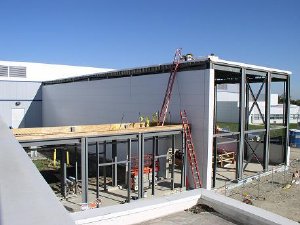
With the spin-polarized capabilities and the ability to characterize insulating samples, this instrument will propel the CNM to the forefront of science using scanning probes to pursue fundamental materials research. A new building was constructed adjacent to the CNM to house the LT-SPM, which requires a highly stable operating environment that is free of acoustic and vibratory interference. The microscope also produces relatively large stray magnetic fields that are incompatible with instruments in the CNM, which was designed specifically to be free of magnetic fields.
The LT-SPM is a necessary to tool for important scientific research, so a new building was designed to specifically hold the machine and place it far enough away from the CNM that the magnetic fields would not pose a problem to other instruments in the building.
Construction on the building was finished at the end of September and the facility will be ready for occupancy by the end of fall.
The building cost $1.5 million and was paid for Institutional General Plant Project funds from the laboratory.