The U.S. Department of Energy (DOE) awarded Argonne National Laboratory nearly $2.7 million in American Recovery and Reinvestment Act (ARRA) funding for three solar-energy related research projects. In addition, Argonne will share another $5 million in ARRA funding for projects with Commonwealth Edison Co., GridPoint and the University of Illinois Sustainable Technology Center (ISTC).
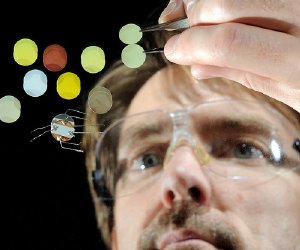 Argonne chemist Jeff Elam examines solar cell materials prepared using atomic layer deposition at various stages of fabrication.
The awards are part of DOE’s investment to support the development of new solar energy technologies and the rapid deployment of available carbon-free solar energy systems. "This investment will help accelerate the use of solar energy by residents, businesses and communities, and promote the long-term viability of solar energy by investing in the technologies of the future," Energy Secretary Chu said.
"This research funding comes at a time when the nation is increasingly looking to renewable energy technologies like solar energy to address concerns related to the climate and energy security," said Argonne Director Eric Isaacs. "Solar energy still has some technology challenges that must to be addressed before large-scale deployment is possible. Fortunately, Argonne has a team of scientists that are aggressively seeking to address those challenges."
Argonne materials scientist Dileep Singh will lead a $1 million project to enhance the heat transfer properties and heat capacity of high-temperature fluids and the capability of solar-to-thermal conversion for improved thermal energy storage and for overall cost reduction of concentrated solar power systems.
A second project lead by Jeffrey Elam, a chemist, will receive $945,000 to develop new technology for the atomic layer deposition of transparent conducting coatings that would enable the production and reduce the manufacturing costs of a broad range of photovoltaic devices.
Alex Martinson, a chemist, is the principal investigator for a $750,000 project to develop high efficiency thin film photovoltaics from layers of interwoven low-cost and unconventional materials. The thin film PV material has the potential to meet or exceed the efficiency of current commercial PV systems while also reducing the cost of materials and processing, and would also help to reach DOE's goal of providing low cost power from photovoltaics on a national scale.
The project with ComEd, GridPoint, and ISTC involves the procurement, installation, and testing of distributed photovoltaic systems on a sample of homes in the Chicago area. The sample homes will also have smart meters installed under ComEd’s new Advanced Metering Infrastructure (AMI) initiative. Some of the systems will even include battery storage. The goal is to understand how consumers respond to the availability of advanced pricing information, net metering, photovoltaics and energy storage. Additionally, the project will examine the impacts to utility grid reliability of distributed PV within an AMI footprint. Energy systems engineer Tom Veselka will lead this project for Argonne.
DOE’s Office of Energy Efficiency and Renewable Energy (EERE) funded these projects.
Argonne National Laboratory seeks solutions to pressing national problems in science and technology. The nation's first national laboratory, Argonne conducts leading-edge basic and applied scientific research in virtually every scientific discipline. Argonne researchers work closely with researchers from hundreds of companies, universities, and federal, state and municipal agencies to help them solve their specific problems, advance America 's scientific leadership and prepare the nation for a better future. With employees from more than 60 nations, Argonne is managed by UChicago Argonne, LLC for the U.S. Department of Energy's Office of Science.