Particle beams are once again zooming around the world's most powerful particle accelerator-the Large Hadron Collider-located at the CERN laboratory near Geneva, Switzerland. On November 20 at 4:00 p.m. EST, a clockwise circulating beam was established in the LHC's 17-mile ring.
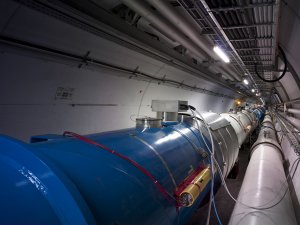 The LHC's 17-mile-long string of magnets has been repaired and beams are once more circulating in the world's most powerful particle accelerator. (Courtesy CERN)
After more than one year of repairs, the LHC is now back on track to create high-energy particle collisions that may yield extraordinary insights into the nature of the physical universe.
“The LHC is a machine unprecedented in size, in complexity, and in the scope of the international collaboration that has built it over the last 15 years,” said Dennis Kovar, U.S. Department of Energy Associate Director of Science for High Energy Physics. “I congratulate the scientists and engineers that have worked to get the LHC back up and running, and look forward to the discoveries to come.”
American scientists have played an important role in the construction of the LHC. About 150 scientists, engineers and technicians from three DOE national laboratories-Brookhaven Lab, Fermilab and Berkeley Lab-built critical accelerator components. They are joined by colleagues from DOE's SLAC National Accelerator Laboratory and the University of Texas at Austin in ongoing LHC accelerator R&D. The work has been supported by the DOE Office of Science.
Circulating beams are a major milestone on the way to the ultimate goal: data from high-energy particle collisions in each of the LHC's four major particle detectors. Over the next few months, scientists will create collisions between two beams of protons. These very first LHC collisions will take place at the relatively low energy of 900 GeV. They will then raise the beam energy, aiming for collisions at the world-record energy of 7 TeV in early 2010. With these high-energy collisions, the hunt for discoveries at the LHC will begin.
“It's great to see beam circulating in the LHC again” said CERN's Director for Accelerators, Steve Myers. “We've still got some way to go before physics can begin, but with this milestone we're well on the way.”
In all, an estimated 10,000 people from 60 countries have helped design and build the LHC accelerator and its four massive particle detectors, including more than 1,700 scientists, engineers, students and technicians from 97 U.S. universities and laboratories in 32 states and Puerto Rico supported by the DOE Office of Science and the National Science Foundation.