Scientists at the U.S. Department of Energy's Argonne National Laboratory have discovered the microscopic mechanism behind the phenomenon of superinsulation, the ability of certain materials to completely block the flow of electric current at low temperatures. The essence of the mechanism is what the authors termed "multi-stage energy relaxation."
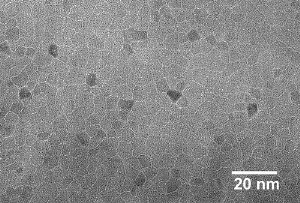 An electron microscopy image of titanium nitride, on which the effect of superinsulation was first observed. Courtesy Argonne National Laboratory.
Traditionally, energy dissipation accompanying current flow is viewed as disadvantageous, as it transforms electricity into heat and thus results in power losses. In arrays of tunnel junctions that are the basic building units of modern electronics, this dissipation permits the generation of current.
Argonne scientist Valerii Vinokour, along with Russian scientists Tatyana Baturina and Nikolai Chtchelkatchev, found that at very low temperatures the energy transfer from tunneling electrons to the thermal environment may occur in several stages.
"First, the passing electrons lose their energy not directly to the heat bath; they transfer their energy to electron-hole plasma, which they generate themselves," Vinokour said. "Then this plasma 'cloud' transforms the acquired energy into the heat. Thus, tunneling current is controlled by the properties of this electron-hole cloud."
As long as the electrons and holes in the plasma cloud are able to move freely, they can serve as a reservoir for energy—but below certain temperatures, electrons and holes become bound into pairs. This does not allow for the transfer of energy from tunneling electrons and impedes the tunneling current, sending the conductivity of the entire system to zero.
"Electron-hole plasma disappears from the game and electrons cannot generate the energy exchange necessary for tunneling," Vinokour said.
Because the current transfer in thin films and granular systems that exhibit superinsulating behavior relies on electron tunneling, the multistage relaxation explains the origin of the superinsulators.
Superinsulation is the opposite of superconductivity; instead of a material that has no resistivity, a superinsulator has a near-infinite resistance. Integration of the two materials may allow for the creation of a new class of quantum electronic devices. This discovery may one day allow researchers to create super-sensitive sensors and other electronic devices.
An earlier paper on the discovery of superinsulation was published in Nature on April 3, 2008. A paper on the mechanism behind superinsulation has been published in Physical Review Letters.