Scientists at the U.S. Department of Energy's (DOE) Argonne National Laboratory and Northwestern University have discovered that common bacteria can turn microgears when suspended in a solution, providing insights for designs of bio-inspired dynamically adaptive materials for energy.
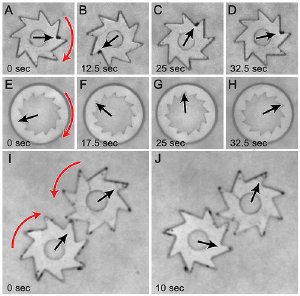 Diagram tracking the movement of gears turned by the bacteria.
“The ability to harness and control the power of bacterial motion is an important requirement for further development of hybrid biomechanical systems driven by microorganisms," said Argonne physicist and principal investigator Igor Aronson. “In this system, the gears are a million times more massive than the bacteria."
The microgears, just 380 microns long with slanted spokes, are produced in collaboration with Northwestern University and placed in the solution along with the common aerobic bacteria Bacillus subtilis. Andrey Sokolov of Princeton University and Igor Aronson from Argonne, along with Bartosz A. Grzybowski and Mario M. Apodaca from Northwestern University, observed that the bacteria appeared to swim at random—but occasionally the organisms collided with the spokes of the gear and began turning it in a definite direction.
A few hundred bacteria work together in order to turn the gear. When multiple gears are placed in the solution with the spokes connected as in a clock, the bacteria will turn both gears in opposite directions, causing the gears to rotate in synchrony—even for long stretches of time.
“There exists a wide gap between man-made hard materials and living tissues; biological materials, unlike steel or plastics, are 'alive,'" Aronson said. "Our discovery demonstrates how microscopic swimming agents, such as bacteria or man-made nanorobots, in combination with hard materials, can constitute a ‘smart material' which can dynamically alter its microstructures, repair damage, or power microdevices."
The speed at which the gears turn can also be controlled through the manipulation of oxygen in the suspended liquid. The bacteria need oxygen in order to swim, and by decreasing the amount of oxygen available, researchers can slow down the gears' movement. Eliminating the oxygen halts the movement entirely.
Once the oxygen is reintroduced into the system, the bacteria “wake up” and begin swimming once again.
A paper on this subject is published in Proceedings of the National Academy of Sciences.
The research at Argonne was supported by the DOE Office of Science (SC). Work at Northwestern University was supported as part of the Non-equilibrium Energy Research Center (NERC), an Energy Frontier Research Center also funded by SC.