The companies BASF, OSRAM Opto Semiconductors, Philips and AIXTRON today (January 11, 2010) confirmed that they had received commitment for funding of the new joint "TOPAS 2012," the second phase of the OLED 2015 initiative of the Federal Ministry of Education and Research (BMBF).
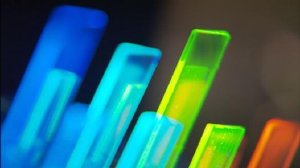 Phosphorescent emitter materials for organic light-emitting diodes (OLED) are tested under UV light. These phosphorescent emitters are semiconductive metal complexes which emit light of the desired wavelength.
TOPAS stands for "thousand Lumen organic phosphorescent devices for applications in lighting systems". In this project, the consortium partners will focus on developing innovative material and component architectures and well as new production machines for lighting solutions with highly efficient organic light-emitting diodes (OLEDs). In doing so, the partners can build on successful joint developments from the previous project "OPAL 2008," which was also sponsored by the BMBF.
"BASF’s materials have already demonstrated their potential in very efficient diodes with lifetimes of several thousand hours and extremely high quantum yields," explained Dr. Elmar Keßenich, project manager at BASF Future Business GmbH. This is already a major step toward the next goal of achieving lifetimes of more than 10,000 hours, which is approximately 10-times longer than the life of a traditional light bulb. In addition to high efficiency and a long lifetime, a high CRI (color rendering index, >80) is also crucial to ensuring excellent light quality. CRI values in excess of 90 can be achieved with BASF’s portfolio of emitters. In the area of materials, BASF works with partners from the University of Bayreuth, the Technical Universities of Dresden and Braunschweig, and the University of Munich. The development of emitters is essential to progress in OLED technology.
"The endorsement of our work and the funding of the TOPAS 2012 project by the BMBF strengthen our outstanding position in OLED research – also with regard to international competition," said Dr. Karsten Heuser, project coordinator and head of OLED activities at OSRAM Opto Semiconductors.
Research within the TOPAS 2012 project will focus on the development of OLEDs for the lighting systems of the future. This will require all primary colors, in particular highly efficient and stable blue emitters, which are not currently available on the market. Blue emitters ensure that it is possible to achieve all color temperatures from cool to warm white using OLED lighting. Vapor-deposited materials are currently considered to be state-of-the-art and provide long lifetimes and high luminous flux and efficiency. Within the project group OSRAM Opto Semiconductors is focusing on a transparent OLED solution with an area of 1 square meter. Philips is concentrating on developing particularly bright monolithic OLED systems with 1000 Lumen, and AIXTRON is working on production equipment with high-grade deposition concepts based on its OVPD (see below).
"Because lighting accounts for around 20 percent of global energy consumption, the development of energy-saving lighting solutions plays a particularly important role in reducing CO2 emissions and thus combating global warming," explained Dr. Dietrich Bertram, head of OLED activities at Philips. OLED technology offers a number of advantages since it is already more efficient than conventional halogen lamps and is expected to achieve the efficiency of low-energy bulbs in the future. In addition, it allows novel flat designs and dispenses with the need of energy-hungry diffusers. As well as offering new design possibilities, flat OLED light sources only a few micrometers thick are also much more user-friendly: They do not dazzle and cast less harsh shadows compared to many conventional point light sources.