At today's International Solid State Circuit Conference, imec and Holst Centre report an analog-signal processor ASIC (application-specific integrated circuit) - in short ASP - that reduces the overall power consumption of an ambulatory heart activity signal monitoring systems by more than 5 times. This is a major step towards autonomous wireless sensor systems powered, which constantly monitor the patient's health for diagnosis or chronic illness.
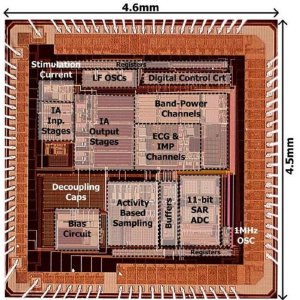 Die photograph of imec and Holst Centre’s 30µW analog signal processor ASIC for biopotential signal monitoring.
In today's biomedical wireless sensor systems, a lot of power consumption is wasted in the DSP (digital signal processor) or radio by continuously processing biopotential signals (e.g. ECG or electrocardiogram), or transmitting raw data over the wireless link. And, today's ambulatory biomedical sensor systems also suffer from motion artifacts which affects the robustness of detection algorithms and demands even more processing power.
The innovative ASP, developed within imec's and Holst Centre's HUMAN++ program, uses an adaptive sampling scheme based on activity detection. This reduces the amount of data which needs to be processed by the DSP or transmitted by the radio. By preprocessing the signal, a simplified DSP can be used for accurate R-peak detection resulting in lower power consumption of the DSP. Motion artifacts are detected by continuously monitoring the electrode-tissue impedance. The impedance monitoring can also be used for ensuring signal integrity by continuously checking the electrode connectivity.
The ASP has a record low power consumption of only 30µW operating from 2V. It consists of an ECG readout channel, two quadrature readout channels for continuous-time monitoring of electrode-tissue impedance, and two quadrature readout channels for tracking signal fluctuations in a specific frequency band. The ASP also includes an activity detector that senses the frequency content of the ECG signal and adapts the sampling rate of the integrated ADC (analog to digital convertor) for the digitization of the ECG signal. The ASP stage reduces the power consumption of the DSP and wireless transmission by 11 and 6 times respectively. This results in an overall system power dissipation below 300µW for the complete wireless heart activity signal monitoring system which is more than 5 times more power efficient than its predecessors. This power budget also includes the additional functionality of continuous-time electrode-tissue contact impedance measurement.
“Within the Human++ program, imec and Holst Centre develop solutions for an efficient and better healthcare. Self-powered intelligent body area networks with wireless sensors promise to be a solution for more comfortable healthcare systems. This breakthrough is a major step towards constant ambulatory monitoring of people using energy harvesting, which increases the comfort level of patients and is a cost- and time-efficient alternative for current monitoring systems;” said Bert Gyselinckx, general manager imec the Netherlands at Holst Centre.
Industry can get access to this technology by joining the Human++ program as research partner or by licensing agreements for further product development.
At this week's International Solid State Circuit Conference, imec and Holst Centre present their newest breakthroughs in ultra-low power design for wireless communications and wireless sensor networks and in organic electronics with an impressive number of contributions including 10 reviewed publications and 6 contributions to tutorials and workshops.
Imec performs world-leading research in nano-electronics. Imec leverages its scientific knowledge with the innovative power of its global partnerships in ICT, healthcare and energy. Imec delivers industry-relevant technology solutions. In a unique high-tech environment, its international top talent is committed to providing the building blocks for a better life in a sustainable society.