Feb 23 2010
The Division of Drug Delivery Technology is part of the Leiden/Amsterdam Center for Drug Research (LACDR), a research institute located at the Gorlaeus laboratories in Leiden in the Netherlands. The group focuses primarily on vaccine delivery and on protein formulation and characterization with respect to immunogenicity. Nanoparticle size and count is vital to these research activities and the Division has selected the NanoSight LM20 to aid their programs.
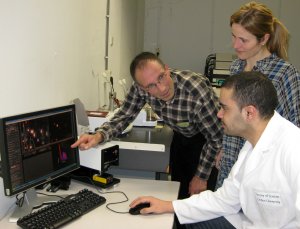 Professor Wim Jiskoot with Andrea Hawe and Vasco Filipe at Leiden University discuss results from the NanoSight LM20 system.
The leader of the team is Professor Wim Jiskoot. He describes what is important for his research: "The vaccine delivery group aims to develop innovative delivery systems, such as polymeric nanoparticles and liposomes, for the delivery of different types of vaccines through the conventional (injection) or needle-free administration routes (such as transcutaneous or intranasal delivery). It is very important to know the size of the delivery systems as the size can influence the uptake by the cells of the immune system, the diffusion through the skin, the release of vaccine components, and thus the immune response."
The protein characterization group seeks to understand the causes of unwanted immunogenicity of therapeutic proteins and develop transgenic mouse models capable of predicting immunogenicity of human/humanized proteins in a preclinical setting. Professor Jiskoot continues: "For the protein group, a good size characterization of protein aggregates is essential to better understand which size class is responsible for triggering unwanted immunogenicity of therapeutic proteins which is believed to be related to the presence of aggregates in the protein formulations. The group aims to stress and thoroughly characterize protein formulations to then test which ones are more immunogenic after their injection in the mouse models."
Prior to using NanoSight's LM20 system, the group used a variety of established particle characterization techniques such as Dynamic Light Scattering (DLS), Light Obscuration Particle Counting (LOPC) and Electron Microscopy (EM). However, each has deficiencies in terms of parameters such as sample preparation and speed of use. The main user is Vasco Filipe and he has seen several benefits which make the NanoSight his system of preference. "We are able to visualize the sample which gives us confidence in our results. Individual particle tracking enables a much better peak resolution than DLS so making it better suited to study polydispersed samples. It gives an approximate particle concentration while letting us see bacterial contamination easily as "swimming" particles."
To learn more about nanoparticle characterization using Nanoparticle Tracking Analysis (NTA), please visit the company's website and register for the latest issue of NanoTrail, the company's electronic newsletter.