Physicists at the National Institute of Standards and Technology (NIST) have built and tested a device for trapping electrically charged atoms (ions) that potentially could process dozens of ions at once with the most versatile control of any trap demonstrated to date. The novel design is a first attempt to systematically scale up from traps that hold a few ions in a few locations to large trap arrays that can process many ions simultaneously, with the ultimate goal of building a practical quantum computer.
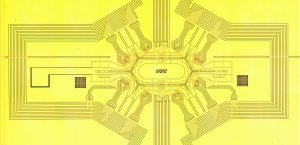 Photograph of NIST racetrack ion trap under development as possible hardware for a future quantum computer. The 150 zones for storing, transporting and probing ions (electrically charged atoms) are located in the center ring structure and the six channels radiating out from its edges. Credit: J. Amini/NIST
If they can be built, quantum computers would rely on the curious rules of quantum mechanics to solve certain currently intractable problems, such as breaking today’s most widely used data encryption codes. The same NIST research group has previously demonstrated various components and operations of a potential quantum computer using ions as quantum bits (qubits). The trap structure is only one component, analogous to the wiring in today’s computers. Lasers are also needed to control and use the quantum data, as transistors do for classical bits today.
Made of a quartz wafer coated with gold in an oval shape roughly 2 by 4 millimeters, NIST’s “racetrack” ion trap features 150 work zones where qubits—ions encoding 1s and 0s in their “spins”—could be stored and transported using electric fields and manipulated with laser beams for information processing. The trap theoretically could be scaled up to a much larger number of zones and mass fabricated in a variety of materials. Preliminary testing of the trap, including loading of 10 magnesium ions at once and transport of an ion through a junction between channels, is described in a new paper.*
Geometry is a key feature of the new trap design. This is the first demonstration of ion transport through a junction in a trap where all electrodes are located on one flat surface, a more scalable design than the multilayer ion traps originally developed. The various electrodes are used to position and move the ions. At least three adjacent electrodes are needed to hold an ion in a dedicated energy “well.” This well and the ion can then be moved around to different locations by applying voltages to several other electrodes. The modular design would allow the addition of extra rings, which could significantly increase capabilities, according to Jason Amini, who designed the trap while a NIST postdoctoral researcher and is now at the Georgia Tech Quantum Institute in Atlanta.
“The trap design demonstrates the use of a basic component library that can be quickly assembled to form structures optimized for a particular experiment,” Amini says. “We can imagine rapid development of traps tailored to individual experiments.”
NIST scientists are continuing development of the racetrack ion trap as well as other designs. The new work was funded in part by the Intelligence Advanced Research Projects Activity and the Office of Naval Research. Four of the 10 authors of the new paper were postdoctoral or guest researchers at NIST at the time of the research and are currently affiliated with the Georgia Tech Quantum Institute, Atlanta, Ga.; Council for Scientific and Industrial Research, Pretoria, South Africa; Centre for Quantum Technologies, National University of Singapore; and Institut Neel-CNRS, Grenoble, France.
* J.M. Amini, H. Uys, J.H. Wesenberg, S. Seidelin, J. Britton, J.J. Bollinger, D. Leibfried, C. Ospelkaus, A.P. VanDevender and D.J. Wineland. Toward scalable ion traps for quantum information processing. New Journal of Physics. March 16, 2010.