A closer look at a promising nanotube coating that might one day improve solar cells has turned up a few unexpected wrinkles, according to new research* conducted at the National Institute of Standards and Technology (NIST) and North Dakota State University (NDSU)-research that also may help scientists iron out a solution.
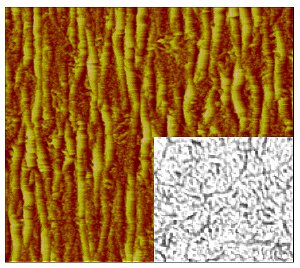 This atomic-force microscopy image shows wrinkling in a single-wall carbon nanotube membrane; the inset shows an optical reflection micrograph of the membrane without any strain. The random arrangement of the nanotubes shown in the inset creates conductivity, but wrinkling can disrupt that. Each image is 40 micrometers in width. Credit: NIST
The scientists have found that coatings made of single-walled carbon nanotubes (SWCNTs) are not quite as deformable as hoped, implying that they are not an easy answer to problems that other materials present. Though films made of nanotubes possess many desirable properties, the team’s findings reveal some issues that might need to be addressed before the full potential of these coatings is realized.
“The irony of these nanotube coatings is that they can change when they bend,” says Erik Hobbie, now the director of the Materials and Nanotechnology program at NDSU. “Under modest strains, these films can develop irreversible changes in nanotube arrangement that reduce their conductivity. Our work is the first to suggest this, and it opens up new approaches to engineering the films in ways that minimize these effects.”
High on the wish list of the solar power industry is a cheap, flexible, transparent coating that can conduct electricity. If this combination of properties can somehow be realized in a single material, solar cells might become far less expensive, and manufacturers might be able to put them in unexpected places—such as articles of clothing. Transparent conductive coatings can be made of indium-tin oxide, but their rigidity and high cost make them less practical for widespread use.
Carbon nanotubes are one possible solution. Nanotubes, which resemble microscopic rolls of chicken wire, are inexpensive, easy to produce, and can be formed en masse into transparent conductive coatings whose weblike inner structure makes them not only strong but deformable, like paper or fabric. However, the team’s research found that some kinds of stretching cause microscopic ‘wrinkles’ in the coating that disrupt the random arrangement of the nanotubes, which is what makes the coating conduct electricity.
“You want the nanotubes to stay randomly arranged,” Hobbie says. “But when a nanotube coating wrinkles, it can lose the connected network that gives it conductivity. Instead, the nanotubes bundle irreversibly into ropelike formations.”
Hobbie says the study suggests a few ways to address the problem, however. The films might be kept thin enough so the wrinkling might be avoided in the first place, or designers could engineer a second interpenetrating polymer network that would support the nanotube network, to keep it from changing too much in response to stress. “These approaches might allow us to make coatings of nanotubes that could withstand large strains while retaining the traits we want,” Hobbie says.
* E. K. Hobbie, D. O. Simien, J. A. Fagan, J. Y. Huh, J. Y.Chung, S. D. Hudson, J. Obrzut, J. F. Douglas, and C. M. Stafford. Wrinkling and Strain Softening in Single-Wall Carbon Nanotube Membranes. Physical Review Letters, March 26, 2010, 104, 125505.