Light-emitting diodes, which employ semiconductors to produce artificial light, could reduce electricity consumption and lighten the impact of greenhouse gas emissions. However, moving this technology beyond traffic signals and laser pointers to illumination for office buildings and homes-the single largest use of electricity-requires materials that emit bright, white light cheaply and efficiently. White light is the mix of all the colors, or wavelengths, in the visible spectrum.
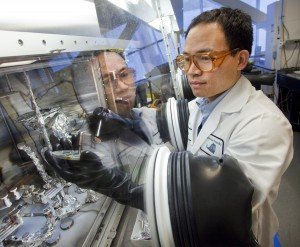 Biwu Ma, a staff scientist with the Molecular Foundry, was part of a research team that found a new way to process white OLEDs for solid state lighting. (Photo by Roy Kaltschmidt, Berkeley Lab Public Affairs)
Organic light-emitting diodes (OLEDs), based on organic and/or polymer semiconductor materials, are promising candidates for general lighting applications, as they can cover large-area displays or panels using low-cost processing techniques. Indeed, single-color OLED displays are already available commercially. A mix of red-, green- and blue-emitting materials can be used to generate white light, but these bands of color often interact with one another, degrading device performance and reducing color quality.
Using polymer nanoparticles to house light-emitting 'inks', scientists at the Molecular Foundry, a U.S. Department of Energy nanoscience center located at Berkeley Lab, and the University of California, Berkeley, have made a thin film OLED using iridium-based guest molecules to emit various colors of visible light. The polymer nanoparticle surrounding a guest light-emitter serves as a 'do not disturb' sign, isolating guest molecules from one another. Each guest can then emit light without pesky interactions with neighboring nanoparticles, resulting in white luminescence.
“This simple and bright approach to achieving nanoscale site isolation of phosphors opens a new door for facile processing of white OLEDs for solid state lighting,” said Biwu Ma, a staff scientist with the Molecular Foundry's Organic Nanostructures Facility who contributed to this study. With this proof-of-concept device under their belts, Ma and his colleagues plan to vary the ratio of each color nanoparticle in the OLED to enhance efficiency and brightness. White light from OLEDs can be adjusted from cooler to warmer whites, making these materials easy to use in office or home environments. Buildings account for more than 40 percent of carbon emissions in the United States, so replacing even a fraction of conventional lighting with OLEDs could result in a significant reduction in electricity use.
A paper reporting this research titled, “Site isolation of emitters within cross-linked polymer nanoparticles for white electroluminescence,” appears in the journal Nano Letters and is available in Nano Letters online. Co-authoring the paper with Ma, were Haifeng Gao, Daniel Poulsen and Jean Fréchet of Berkeley Lab's Materials Sciences Division, plus David Unruh, Xiaoyong Zhao and Jill Millstone with the UC Berkeley Chemistry Dpeartment.
Portions of this work at the Molecular Foundry were supported by DOE's Office of Science.
The Molecular Foundry is one of the five DOE Nanoscale Science Research Centers (NSRCs), premier national user facilities for interdisciplinary research at the nanoscale. Together the NSRCs comprise a suite of complementary facilities that provide researchers with state-of-the-art capabilities to fabricate, process, characterize and model nanoscale materials, and constitute the largest infrastructure investment of the National Nanotechnology Initiative. The NSRCs are located at DOE's Argonne, Brookhaven, Lawrence Berkeley, Oak Ridge and Sandia and Los Alamos National Laboratories.