The recent eruption of Iceland’s Eyjafjallajokull volcano and the subsequent massive shutdown of air traffic in Europe occupied the attention of travelers and worldwide news agencies for weeks. When the volcano first erupted in March, the world took little notice. However, on April 14, the volcano discharged a massive cloud of ash into the atmosphere.
Concerned, European officials decided to close down a huge area of European airspace, completely interrupting air travel for days. The question that concerned European officials was whether there was a sufficient amount of volcanic ash in the atmosphere to cause damage to aircraft.
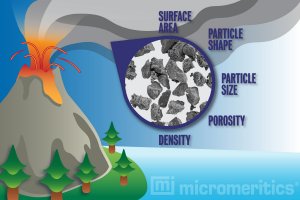
The fact that volcanic ash can damage aircraft engines is not in dispute. There are plenty of examples of engine failures upon encountering volcanic ash clouds. However, danger to aircraft is only one of the problems created by the introduction of volcanic ash into the atmosphere. Ash can also have negative effects on human health, agriculture, and the ecology. Whether or not any of these possible negative effects occur depends largely on the physical characteristics of the ash – namely particle size, shape, surface area, porosity, density, and hardness.
SiO2-rich glass shard particles, formed when rocks are pulverized by an eruption, comprise a principal contaminant in a volcanic ash plume discharge. Silica is extremely hard. The combination of the high hardness and irregular shape of these particles makes them very abrasive. Teardowns of engines after ash exposure have revealed the damage caused by these particles. Volcanic ash may clog air filters of turbine engines, block cooling air passages, and erode the gas path components and protective paint on casings. Silicate ash entering the engine at a significant relative speed can melt in the hot section of the engine and then re-solidify on the high pressure turbine blades and guide vanes, potentially choking the turbine airflow and leading to surging and an in-flight shutdown.
Falling ash particles far from an eruption can pose numerous hazards to the environment, human and animal health, agriculture, appliances, communications, power generating facilities, and water supply systems. Fine ash particles (smaller than 10 micrometers in size) can enter the pulmonary section of the lungs and cause severe respiratory problems. In an eruption, fluorine aerosols can become attached to fine ash particles. Due to their large surface area, fine particles can transport significant amounts of soluble fluorine onto pastures far downwind from an erupting volcano. A thin layer of fine ash only 1 millimeter thick can contain potentially toxic amounts of fluorine. Fluorosis can kill livestock who graze on these ash-contaminated pastures. Fruit and vegetables ready for harvest that are covered with ash-fall can be hard to clean, effectively destroying the crop. The abrasive and corrosive nature of ash can damage machinery, appliances, computers, electrical and mechanical systems. Large quantities of electrically charged ash can contribute to the interference of radio waves and render radio and telephone systems inoperative.
The general term for fragmented volcanic material is “tephra.” There are three classifications based on grain size. ‘Bombs’ and ‘Blocks’ comprise the largest classification measuring greater than 64 millimeters. ‘Lapilli’ makes up the mid-range of particles measuring from 2 to 64 millimeters. Volcanic ash is the finest grade of ejected solid debris containing particles ranging from 2 millimeters down to micrometer-scale. Particles relatively close to the eruption plume have a larger particle size range and higher apparent density then that in downwind ash clouds. Volcanic ash particles have a relatively low apparent density for rock materials due to even the finest particles having numerous pores and voids. These particles can rise to the higher levels of the plume at the site of the eruption. Remaining in suspension at prevailing ambient air densities, upper winds transport these particles to eventual dispersal in an ash cloud. The atmospheric dispersal of airborne volcanic ash depends on the type and magnitude of the eruption, wind direction, and the size and apparent density of the ash particles. It is generally accepted that ash clouds far downwind from the eruption contain fine ash particles with a particle size distribution of less than 200 micrometers that have a much smaller settling rate.
Many models for studying volcanic ash transport include a variety of measurement parameters such as an accurate description of the shape and explosivity of the ash plume, thermodynamic cloud modeling to investigate cloud destabilization through water phase changes, and wind field data. However, with most of these models, size, shape, surface area, and porosity of the particles are all very important factors in determining how far fine volcanic ash will travel. Many studies have indicated a rapid thinning and fining of collected particle subpopulations with distance from the volcano. Therefore, particle size distribution measurements of pristine volcanic ash at various distances from an eruption provide a very important piece of the puzzle for predicting ash transport in future events. Particle shape and porosity affect the velocity with which a particle will fall from the atmosphere. BET surface area analyses indicate that irregular shape and porosity contribute to the high surface area of fine ash particles. This irregular shape and porosity creates drag and therefore affect how far a particle can be transported by wind and how quickly it will fall out of the atmosphere. These characteristics can slow the terminal velocity of particles below 500 micrometers by orders of magnitude.
Micromeritics offers a number of analytical instruments for determining physical characteristics of volcanic ash particles. The SediGraph III determines the size of particles, from 300 to 0.1 micrometer, and sedimentation velocity, based upon sedimentation through a known fluid. Complete particle accountability assures that the entire introduced sample is accounted for. The SediGraph III measures mass by X-ray absorption and particle size by sedimentation– no modeling is required. The Particle Insight determines up to 28 different shape parameters analyzed in real-time for a range of particle shape models, from spherical, through elliptical, to fiber and rod shapes, as well as multi-faceted polyhedral. The Saturn DigiSizer II digital, high-definition laser light scattering particle size analyzer can provide an extremely high level of resolution and sensitivity for size measurements at the upper end of the “ash” range, for particles as large as 2500 micrometers. Micromeritics TriStar II, Gemini VII, and ASAP 2020 and 2420 all can be used to determine both BET surface areas and total pore volume distributions, for pores as small as 0.4 nm to as large as 400 nm. Micromeritics’ AccuPyc II 1340 Gas Pycnometer provides skeletal volume and density measurements on materials having volumes from 0.01 to 350 cm3. Micromeritics’ GeoPyc 1360 Pycnometer can determine the bulk volume and density of ash materials. The AutoPore IV mercury porosimeter can determine apparent and skeletal densities as well as the porosity characteristics of the larger ash particles that include lapilli ash up to approximately 25 millimeters diameter.
It may be surprising to many that there are over 530 active volcanoes worldwide. Extensive geologic regions that include most of the planet are at risk from volcanic ash. As noted previously, volcanic ash particles can be carried high into the atmosphere by an eruption and transported long distances by a variety of factors. The damage and economic loss caused by volcanic plume eruptions are potentially staggering. Accurately predicting the transport and fallout of this ash will help to limit the destructive and economic impact of an eruption event. As a result, it is very important to understand and eventually predict with some accuracy the transport of ash particles from a volcanic plume eruption event. Physical characteristics of ash particles are some of the most important factors used in ongoing research aimed at the development of prediction models. Micromeritics’ expertise and its innovative materials characterization instrumentation have already been, and will continue to be, instrumental in providing important measurements required for establishing models for the transport and fallout of volcanic ash.