While those wonderful light sabers in the Star Wars films remain the figment of George Lucas' fertile imagination, light mills - rotary motors driven by light - that can power objects thousands of times greater in size are now fact.
Researchers with the U.S. Department of Energy (DOE)'s Lawrence Berkeley National Laboratory and the University of California (UC) Berkeley have created the first nano-sized light mill motor whose rotational speed and direction can be controlled by tuning the frequency of the incident light waves.
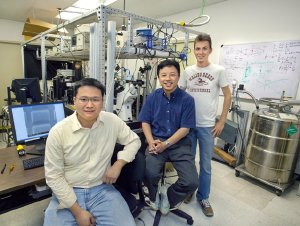 Ming Liu (foreground), Xiang Zhang and Thomas Zentgraf have created the first nano-sized light mill motor whose rotational speed and direction is controlled by the frequency of incident light waves. This should open the door to a broad range of valuable applications in energy and biology as well as in nanoelectromechanical systems. (Photo by Roy Kaltschmidt, Berkeley Lab Public Affairs)
It may not help conquer the Dark Side, but this new light mill does open the door to a broad range of valuable applications, including a new generation of nanoelectromechanical systems (NEMS), nanoscale solar light harvesters, and bots that can perform in vivo manipulations of DNA and other biological molecules.
“We have demonstrated a plasmonic motor only 100 nanometers in size that when illuminated with linearly polarized light can generate a torque sufficient to drive a micrometre-sized silica disk 4,000 times larger in volume,” says Xiang Zhang, a principal investigator with Berkeley Lab's Materials Sciences Division and director of UC Berkeley's Nano-scale Science and Engineering Center (SINAM), who led this research. “In addition to easily being able to control the rotational speed and direction of this motor, we can create coherent arrays of such motors, which results in greater torque and faster rotation of the microdisk.”
The success of this new light mill stems from the fact that the force exerted on matter by light can be enhanced in a metallic nanostructure when the frequencies of the incident light waves are resonant with the metal's plasmons - surface waves that roll through a metal's conduction electrons. Zhang and his colleagues fashioned a gammadion-shaped light mill type of nanomotor out of gold that was structurally designed to maximize the interactions between light and matter. The metamaterial-style structure also induced orbital angular momentum on the light that in turn imposed a torque on the nanomotor.
“The planar gammadion gold structures can be viewed as a combination of four small LC-circuits for which the resonant frequencies are determined by the geometry and dielectric properties of the metal,” says Zhang. “The imposed torque results solely from the gammadion structure's symmetry and interaction with all incident light, including light which doesn't carry angular momentum. Essentially we use design to encode angular momentum in the structure itself. Since the angular momentum of the light need not be pre-determined, the illuminating source can be a simple linearly polarized plane-wave or Gaussian beam.”
The results of this research are reported in the journal Nature Nanotechnology in a paper titled, “ Light-driven nanoscale plasmonic motors.” Co-authoring the paper with Zhang were Ming Liu, Thomas Zentgraf, Yongmin Liu and Guy Bartal.
It has long been known that the photons in a beam of light carry both linear and angular momentum that can be transferred to a material object. Optical tweezers and traps, for example, are based on the direct transfer of linear momentum. In 1936, Princeton physicist Richard Beth demonstrated that angular momentum - in either its spin or orbital form - when altered by the scattering or absorption of light can produce a mechanical torque on an object. Previous attempts to harness this transfer of angular momentum for a rotary motor have been hampered by the weakness of the interaction between photons and matter.
“The typical motors had to be at least micrometres or even millimeters in size in order to generate a sufficient amount of torque,” says lead author Ming Liu, a PhD student in Zhang's group. “We've shown that in a nanostructure like our gammadion gold light mill, torque is greatly enhanced by the coupling of the incident light to plasmonic waves. The power density of our motors is very high. As a bonus, the rotational direction is controllable, a counterintuitive fact based on what we learn from wind mills.”
The directional change, Liu explains, is made possible by the support of the four-armed gammadion structure for two major resonance modes - a wavelength of 810 nanometers, and a wavelength of 1,700 nanometers. When illuminated with a linearly polarized Gaussian beam of laser light at the shorter wavelength, the plasmonic motor rotated counterclockwise at a rate of 0.3 Hertz. When illuminated with a similar laser beam but at the larger wavelength, the nanomotor rotated at the same rate of speed but in a clockwise direction.
“When multiple motors are integrated into one silica microdisk, the torques applied on the disk from the individual motors accumulate and the overall torque is increased,” Liu says. “For example, a silica disk embedded with four plasmonic nanomotors attains the same rotation speed with only half of the laser power applied as a disk embedded with a single motor.”
The nanoscale size of this new light mill makes it ideal for powering NEMS, where the premium is on size rather than efficiency. Generating relatively powerful torque in a nanosized light mill also has numerous potential biological applications, including the controlled unwinding and rewinding of the DNA double helix. When these light mill motors are structurally optimized for efficiency, they could be useful for harvesting solar energy in nanoscopic systems.
“By designing multiple motors to work at different resonance frequencies and in a single direction, we could acquire torque from the broad range of wavelengths available in sunlight,” Liu says.
This research was supported by DOE's Office of Science.