Imec has fabricated tandem organic solar cells with peak conversion efficiencies of 5.15%. This was achieved by stacking two different planar heterojunction devices, each with a high open-circuit voltage (Voc).
The universal nature of the interconnection scheme makes it easy to incorporate new promising materials in the tandem configuration. The screening of candidate materials is ongoing at imec, with the focus on materials with absorption spectra extended to higher wavelengths. The goal is to combine these new materials with the current tandem set, creating a stack of 3 or more cells that will result in an even broader coverage of the solar spectrum and in higher efficiencies.
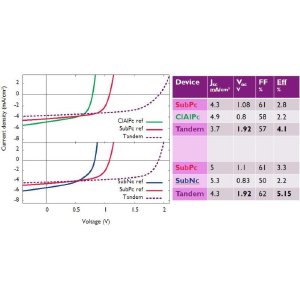 Voltage-current density plots for tandem cells and single cells grown in the same run.
Organic solar cells are conventionally made from two materials: a donor and an acceptor, which facilitates an efficient charge separation. For the acceptor, the most commonly used molecule is one of the blue absorbing fullerenes. This leaves the absorption spectrum of the donor material responsible to cover as much as possible of the solar spectrum. But most organic semiconductors only have a small optical bandwidth. Consequently, solar cells based on such materials only catch a small part of the solar spectrum. This can be overcome with a properly designed stacked or tandem configuration, in which several organic materials each absorb a separate part of the spectrum.
In imec’s current configuration, two single cells are fabricated on top of each other, connected in series to increase the total absorption. The choice of materials is critical as the subcells should have complementary absorption spectra. In this way, light that is not absorbed by one subcell can contribute to the photocurrent in another subcell.
The donor materials in the subcells are phthalocyanine-based. We selected chloroaluminum phthalocyanine (ClAlPc), subnaphthalocyanine (SubNc), and subphthalocyanine (SubPc) as donor materials in combination with C60 as an acceptor. The materials SubNc and ClAlPc have absorption spectra that are complementary with SubPc (580-820nm for ClAlPc, 580-720nm for SubNc, and 470-620nm for SubPc). The energy levels of all material pairs allow for a large Voc (0.85V, 0.82V, and 1.1V, respectively), while the photocurrent is not limited by inefficient exciton dissociation. An important property of the chosen phthalocyanine materials is their extremely high extinction coefficient over a small spectral window. The small absorption width opens possibilities to optimize the available energy after photon absorption, as photo-generated excitons will thermally relax to the lowest excited state. At the same time, the high absorption constant makes it possible to use very thin layers (10-20nm) and still produce a considerable photocurrent (> 4mA/cm²).
Single cells were stacked in a tandem configuration with an all-evaporated, novel interconnection scheme based on an electron-transport layer, metal nanoparticles and a hole-transport layer. This configuration shows no potential drop, leading to Voc values approaching 2V. At the same time, the fill-factor is not hampered and efficiencies above 5% are obtained.
Tandem architectures like this, using carefully selected materials connected in series, are a promising road to organic solar cells with higher efficiencies. Imec is currently screening candidate materials with absorption spectra at higher wavelengths. The goal is to combine these new materials in the current tandem, creating a stack of 3 or more cells.