With growing interest in using nanoparticles for everything from antibacterial socks to medical imaging to electronic devices, the need to understand the environmental, health and safety risks of these particles also grows.
Researchers at the National Institute of Standards and Technology (NIST) have developed a simple process for producing nanocrystals that will enable studies of certain physical and chemical properties that affect how nanoparticles interact with the world around them.
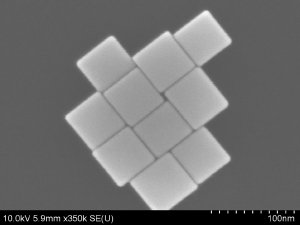 These electron microscope images show perfect-edged nanocubes produced in a one-step process created at NIST that allows careful control of the cubes� size, shape and composition. Credit: NIST
Because nanoparticles behave differently from bulk samples of the same material, new tests to understand how they affect biological systems must be developed. Toxicologists determine the hazards posed by nanoparticles by introducing them to a biological system and monitoring the effects, but they currently lack a set of control particles whose size, shape and composition have been carefully produced and characterized.
In a recent paper published in Angewandte Chemie,* NIST scientists describe a one-step process that allows them to control the size, shape and composition of gold-copper alloy nanocrystals to create perfect-edged nanocubes as small as 3.4 nanometers—just half the thickness of a cell wall and on the same size range as DNA.
The researchers combined and heated gold and copper precursors with other chemicals to produce highly crystalline, homogeneous, perfect nanocubes with abundant yield. To study the formation process, they removed samples at 1 hour, 1.5 hours, 5 hours, and 24 hours and found that just five hours were needed to produce perfectly cubic nanoparticles of uniform size. By adjusting the ratios of the chemicals in the original solution and the reaction time, they were able to precisely control the size, shape and composition of the nanocubes. This process is unique in allowing control of the ratio of copper to gold atoms within the nanocube to either 3:1 or 1:3.
"It's a simple process, and to the best of our knowledge is the first to use synthetic chemistry, or 'bottom up' technology, to produce gold-containing nanocubes below 5 nanometers. Anything less than 10 nanometers has been extremely challenging due to the mobile behavior of the gold atoms," says NIST physicist Angela R. Hight Walker, who wrote the paper with Yonglin Liu, a guest researcher at NIST.
The NIST-developed process for creating such nanocubes will allow toxicologists to systematically alter one of the nanocubes' characteristics and observe how the change affects the biological response, if at all.
This synthesis and the resulting high-quality nanocubes may have other applications in areas such as solar energy, says Liu. "Typically, we cannot make big batches of high-quality samples for testing; now we can."
The perfect-edged nanocubes are unique from other nanocubes in the literature, says Hight Walker. The sharp edges, as opposed to truncated or rounded edges, will enable different, more reactive chemistry that could be beneficial in applications such as catalysis—in which the nanocubes would be used to initiate or enhance a chemical reaction.
*Y. Liu and A.R. Hight Walker. Monodisperse gold-copper bimetallic nanocubes: facile one-step synthesis with controllable size and composition. Angewandte Chemie. Posted online Aug. 16, 2010.