Researchers at the National Institute of Standards and Technology (NIST) have found theoretical evidence* of a new way to generate the high-frequency waves used in modern communication devices such as cell phones. Their analysis, if supported by experimental evidence, could contribute to a new generation of wireless technology that would be more secure and resistant to interference than conventional devices.
The team’s findings point toward an oscillator that would harness the spin of electrons to generate microwaves—electromagnetic waves in the frequencies used by mobile devices. Electron spin is a fundamental property, in addition to basic electrical charge, that can be used in electronic circuits. The discovery adds another potential effect to the list of spin’s capabilities.
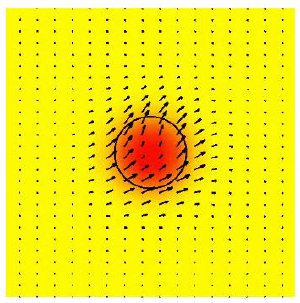 This animation shows the development of the soliton over the course of about 2.7 nanoseconds. Current begins passing through the hole (center), causing the magnetization to oscillate. These oscillations initially move throughout the layer, but after 1.8 ns the magnetization under the hole inverts to form the soliton (center changes to red) and the oscillations are then localized. Credit: NIST
The team’s work—a novel variation on several types of previously proposed experimental oscillators—predicts that a special type of stationary wave called a “soliton” can be created in a layer of a multilayered magnetic sandwich. Solitons are shape-preserving waves that have been seen in a variety of media. (They first were observed in a boat canal in 1834 and now are used in optical fiber communications.) Creating the soliton requires that one of the sandwich layers be magnetized perpendicular to the plane of the sandwiched layers; then an electric current is forced through a small channel in the sandwich. Once the soliton is established, the magnetic orientation oscillates at more than a billion times a second.
“That’s the frequency of microwaves,” says NIST physicist Thomas Silva. “You might use this effect to create an oscillator in cell phones that would use less energy than those in use today. And the military could use them in secure communications as well. In theory, you could change the frequency of these devices quite rapidly, making the signals very hard for enemies to intercept or jam.”
Silva adds that the oscillator is predicted to be very stable—its frequency remaining constant even with variations in current—a distinct practical advantage, as it would reduce unwanted noise in the system. It also appears to create an output signal that would be both steady and strong.
The team’s prediction also has value for fundamental research.
“All we’ve done at this point is the mathematics, but the equations predict these effects will occur in devices that we think we can realize,” Silva says, pointing out that the research was inspired by materials that already exist. “We’d like to start looking for experimental evidence that these localized excitations occur, not least because solitons in other materials are hard to generate. If they occur in these devices as our predictions indicate, we might have found a relatively easy way to explore their properties.”
* M.A. Hoefer, T.J. Silva and M.W. Keller. Theory for a dissipative droplet soliton excited by a spin torque nanocontact. Physical Review B, 82, 054432 (2010), Aug. 30. 2010. DOI: 10.1103/PhysRevB.82.054432