By assembling a crystalline envelope around a cell, surface-layer (S-layer) proteins serve as the first point of contact between bacteria, extremophiles and other types of microbes and their environment.
Now, scientists at the Molecular Foundry, a nanoscience user facility at Berkeley Lab, have used atomic force microscopy to image in real time how S-layer proteins form crystals in a cell-like environment. This direct observation of protein assembly could provide researchers with insight into how microorganisms stave off antibiotics or lock carbon dioxide into minerals.
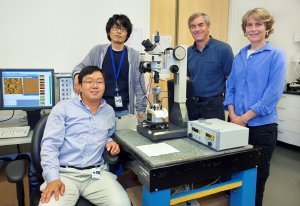 (From left) Sungwook Chung, Seong-Ho Shin, James DeYoreo and Carolyn Bertozzi with Berkeley Lab’s Molecular Foundry, have used atomic force microscopy to study how bacterial surface-layer proteins form crystals in a cell-like environment. (Photo by Roy Kaltschmidt, Berkeley Lab Public Affairs).
“Many proteins self-assemble into highly ordered structures that provide organisms with critical functions, such as cell adhesion to surfaces, transformation of CO2 into minerals, propagation of disease, and drug resistance,” said James DeYoreo, Deputy Director of the Molecular Foundry. “This work is the first to provide a direct molecular-level view of the assembly pathway in vitro. Once this knowledge can be extended to assembly in a living system, it may lead to strategies for capitalizing on or interfering with these functions.”
Unraveling the pathway for S-layer formation allows scientists to investigate how bacteria or other microbes negotiate interactions with their environment. DeYoreo and colleagues employed in situ atomic force microscopy—a probe technique used to study a crystal’s surface in its natural setting with atomic precision—to watch S-layer proteins assemble from solution onto a flat, biological membrane called a lipid bilayer. Unlike classical crystal growth, in which atoms form into ordered ‘seeds’ and grow in size, the team showed S-layer proteins form unstructured blobs on the bilayers before transforming into a crystalline structure over the course of minutes.
“We can actually see these proteins from solution sticking and arranging on the lipid bilayers where they spontaneously condense into many protein blobs—then, minutes later, they transform into a crystalline structure with a square lattice of tetramers,” said Sungwook Chung, a staff scientist in the Physical Biosciences Division and user at the Molecular Foundry. “This is an important discovery as it gives direct evidence for a multi-stage assembly pathway with an intermediate, amorphous phase forming before folding into a two-dimensional, crystalline array.”
Foundry post-doctoral researcher Seong-Ho Shin, working with Foundry Director Carolyn Bertozzi, says understanding how S-layers interact with their environment could help in recognizing how organisms resist antibacterial drugs, or how microbes turn carbon dioxide into solid carbonates. Among the first protein structures to be used to organize nanostructures, S-layers are also attractive scaffold template materials for growing or organizing nanowires or quantum dots.
In a study inspired by this work, Foundry staff scientist Steve Whitelam used computer modeling to investigate crystallization pathways of model S-layer proteins. As model proteins encounter one another, they might stick together at any angle at which they collide (mediated by non-specific interactions), or bind in the correct orientation needed to form a crystal (mediated by directional interactions).
By adjusting these interactions, Whitelam identified parameter regimes within which unstructured blobs of proteins form prior to crystallization. Searching through parameter space, he found crystals often form more reliably if model proteins interacted directionally and nonspecifically, rather than through directional interaction alone. What’s more, he adds, these findings may apply to different kinds of materials.
“Many biological and inorganic materials assemble and crystallize through intermediate phases that are often amorphous,” said Whitelam, who is in the Foundry’s Theory of Nanostructured Materials Facility. “Developing a molecular model of crystallization in a particular system helps us to understand mechanisms of crystallization in general.”
Two papers reporting this research titled, “Self-catalyzed growth of S-layers via an amorphous-to-crystalline transition limited by folding kinetics,” (Chung, Shin, Bertozzi, DeYoreo) appearing in Proceedings of the National Academy of Sciences and “Control of pathways and yields of protein crystallization through the interplay of nonspecific and specific attractions,” (Whitelam) appearing in Physical Review Letters, are available online at (http://www.pnas.org/content/early/2010/09/01/1008280107) and (http://prl.aps.org/abstract/PRL/v105/i8/e088102)
These works were performed at the Molecular Foundry and supported by DOE’s Office of Science.