Imec has used its design against radiation effects DARE library for the commercial 0.18µm UMC CMOS process to design a mixed-signal application-specific integrated circuit (ASIC) for Tesat-Spacecom. Test and qualification steps have demonstrated the suitability of using the DARE library and an analog radiation-hardened by design approach for generating flight-model qualified devices.
Imec designed a radiation tolerant mixed-signal ASIC – nicknamed KNUT – for Tesat-Spacecom GmbH & Co. KG (Germany). With this mixed-signal ASIC, Tesat replaces an existing discrete solution with a purely digital ASIC plus discrete components. The implemented algorithms calculate the current values of 18 configurable current sources depending on configurable parameters and analog-to-digital converter (ADC) inputs. KNUT will be used for low-speed applications such as compensated or regulated bias circuits intended to optimize equipment performance of industrial telecommunication satellites.
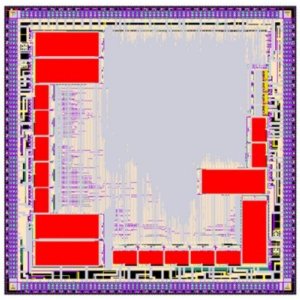 Layout view of the KNUT ASIC.
A digital-on-top approach was chosen as the most appropriate mixed-signal design flow. The digital functions were synthesized from the hardware description language VHDL to imec’s DARE180 digital library. DARE is a radiation-hardened standard cell library for the commercially available 0.18µm UMC technology. It was developed by imec and funded by the European Space Agency. The analog circuit design required imec’s expertise in designing radiation tolerant circuits. A 10 bit current steering digital-to-analog (DAC) and a 10 bit capacitive ADC, both operating at 3.3V, were designed and added to the DARE180 library family. Analog I/O cells with improved electrostatic discharge (ESD) performance for mixed-signal multi-power domain ASICs were created as well.
KNUT prototype devices were fabricated in a multi-project wafer (MPW) run as offered by the EUROPRACTICE IC service. For the flight models a full mask production run was necessary. After intense screening and qualification, the flight modules were selected. The screening procedure included assembly, electrical testing, reliability tests of the package option and drift analysis of the parameters before and after burn-in. For these activities, Tesat relied on imec’s experience on small quantity production support and managing subcontractors for electrical and radiation testing, qualification and assembly.
The resulting devices comply with the ECS generic specification ESCC9000 and will therefore withstand the harsh space environment. Single event upset (SEU) was detected from 55Mev. Single event latch-up (SEL) were not observed till the maximum energy level of 111MeV. The devices remain functional till a total irradiation dose of 200krad (well exceeding the specified total dose of 100krad) and pass the 2000h life test without any device failure. Extreme thermal and mechanical tests proved the reliability of the package. These results clearly demonstrate the feasibility of the UMC/DARE solution for producing flight-model qualified devices.