European FP7 funded project SmartFiber, a consortium led by imec and including partners Ghent University, Airborne, FBGS Technologies, Xenics, Fraunhofer and Optocap, will develop a smart miniaturized system for continuous health monitoring of composites that integrates optical fiber sensor technology, nanophotonic chip technology and low-power wireless technology.
The smart system will enable, for the first time, fully embedded structural health monitoring of composites used as structural parts in e.g. wind turbine blades, satellites, airplanes, civil constructions, oil and gas wells, and boat hulls. Thanks to the innovative approach of integrating micro-technologies, SmartFiber will demonstrate a smart system so small (mm-scale) that it can be embedded in a fiber-reinforced polymer.
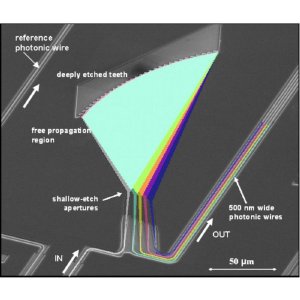 Scanning electron microscopy (SEM) pictures of a 4-channel Si photonics spectral demultiplexer – key building blocks of a photonic integrated circuit.
The enabling technology of this smart system is Si nanophotonics, a technology for which imec, in partnership with its associated laboratory INTEC at Ghent University (UGent), is world leading. The nanophotonic chip technology enables the realization of a fiber interrogation scheme or spectral analyser as a photonic integrated circuit (PIC), which has typical dimensions in the order of several hundreds of micrometer. This low-power PIC will be finished by electrical means for wireless communication and inductive power coupling, packaged in a mm-sized cage and coupled to optical fiber bragg grating (FBG) sensors. This disruptive approach has the potential to become the enabler for continuous FBG sensor technology in composites and to become the true driver to realize intelligent composites.
The minimally invasive smart microsystems will enable automated high-performance surveillance with a prolonged lifetime in dynamic and harsh environments. This will result in extremely improved safety, at economically acceptable cost (automated instead of manual surveillance). Think about wind turbine blade monitoring. The microsystem will enable the turbine to operate much closer to its design limits, increasing wind energy capture and thus electrical energy output. But most of all, it will provide a continuous record of structural data which will inform decisions on maintenance, thereby obviating the need for expensive, periodic maintenance, as well as warning of potentially catastrophic mechanical failures, increasing safety remarkably.
SmartFiber (FP7-STREP SmartFiber, www.smartfiber-fp7.eu) is co-financed by the European commission and coordinated by imec. The industrial involvement in SmartFiber is significant: Xenics, Airborne, FBGS Technologies and Optocap cover almost the full value chain of the microsystem and are perfectly placed to absorb the technologies developed by the research partners imec, UGent and Fraunhofer IIS. This strategy gives industrial take-up and commercial development of the technology a huge chance.